Infusd Introduces Stable Liquid Creatine Enabled by Proprietary Ingredient Delivery Technology
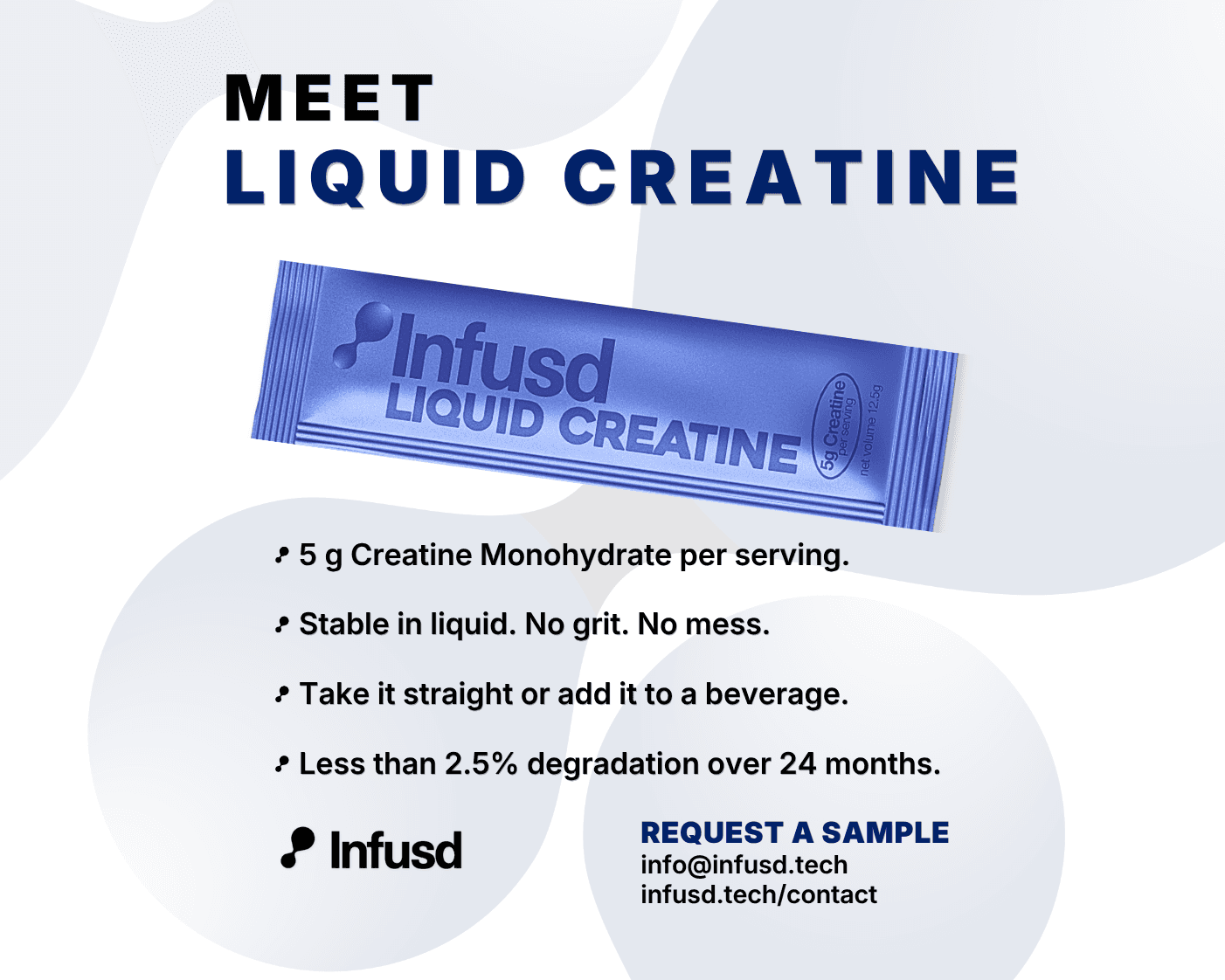
HALIFAX, Nova Scotia (October 20, 2026) Infusd Nutrition has introduced a stable liquid creatine system that holds creatine monohydrate in a liquid format for up to 24 months with less than 2.5% degradation to creatinine. The system contains 40% creatine monohydrate by weight, is available in sachet, syrup, gel, and food-service formats, and can be consumed directly or mixed into water, tea, juice, or coffee. The formulation applies our proprietary ingredient delivery technology to creatine and demonstrates that an ingredient long considered unsuitable for ready-to-consume liquids can be delivered at a full serving without the loss of potency that has characterized earlier liquid creatine products.
Why Creatine Has Resisted Liquid Delivery
Creatine monohydrate is stable as a dry powder and unstable in water. In aqueous solution, the molecule undergoes intramolecular cyclization to creatinine, a metabolic by-product with no documented ergogenic function. The International Society of Sports Nutrition position stand on creatine summarizes the kinetics: conversion accelerates as pH falls and temperature rises. After three days at 25 °C, creatine in solution degrades by approximately 4% at pH 5.5, 12% at pH 4.5, and 21% at pH 3.5. The same source notes that creatine is relatively stable at pH 6.5 to 7.5, that degradation can be reduced or halted by lowering pH below 2.5 or raising it, and that conversion in the gastrointestinal tract is minimal. The problem is storage, not digestion.
The practical consequences for finished products are well documented. A published stability evaluation of effervescent creatine formulations recorded roughly 90% degradation within 45 days of room-temperature storage once the product was in solution. In 2024, NOW Foods tested twelve commercial creatine gummy brands by HPLC and reported that six of the twelve failed to meet label claim, with creatinine detected in every failing sample. The company also reported difficulty finding a third-party laboratory with a validated method for gummy matrices. Separately, industry reporting on the creatine gummy category cited one comparison in which approximately 95% of standard creatine monohydrate in a neutral-pH ready-to-drink beverage had converted to creatinine after 12 months.
Formulators have historically managed this risk in one of three ways: by keeping creatine dry (powders, stick packs, capsules), by buffering aqueous systems to a neutral or alkaline pH that constrains flavor options, or by using microencapsulation systems, whose stability data are largely vendor-reported and require independent verification in the finished matrix. Each approach involves a trade-off between dose integrity, sensory quality, and format. We examined these trade-offs in detail in our earlier articles on whether liquid creatine can be shelf stable for the long term and on how beverage format affects creatine solubility.
Specifications of the Stable Liquid Creatine System
The system is designed to deliver a full creatine dose in liquid form. Its stated specifications are summarized below.
Parameter | Specification |
|---|---|
Active ingredient | Creatine monohydrate |
Payload | 40% creatine monohydrate by weight |
Shelf stability | Up to 24 months in liquid format |
Degradation to creatinine over shelf life | Less than 2.5% |
Formats | Sachets, syrups, direct-consumption gel, food-service applications |
Consumption | Directly from the sachet or gel, or mixed into water, tea, juice, or coffee |
Sensory | No grit, no clumping, no mixing step required; multiple flavors available |
Compatible co-actives | Electrolytes, caffeine, omega-3 fatty acids, and other bioactives |
The 40% payload means a single-serve sachet can carry the 3 to 5 g daily maintenance dose that the ISSN identifies as sufficient to sustain elevated muscle creatine stores once saturation is reached.
The platform supports co-formulation with ingredients that are themselves difficult to hold in stable aqueous systems, including omega-3 fatty acids. This allows a single liquid product to carry creatine alongside electrolytes, caffeine, or omega-3 fatty acids. For teams evaluating multi-active sports products, this reduces the number of separate delivery systems that must be qualified.
How the Technology Enables a Stable Liquid Creatine
Our technology is a proprietary physical processing method that uses natural stabilizers to convert fat-soluble, insoluble, and otherwise unstable ingredients into water-compatible liquid and powder forms. The process does not rely on synthetic emulsifiers, harsh solvents, or chemical modification of the active. Across the platform, our published performance parameters include active payloads of 10% or more, shelf stability of 24 months or longer in real-time studies, and tolerance to pasteurization, UHT treatment, carbonation, and freezing.
Creatine is a different problem from the omega-3s and fat-soluble vitamins that the platform was first applied to. Creatine dissolves in water readily enough; the issue is what happens to it once dissolved. The liquid creatine system applies the same physical processing and natural stabilizers to creatine, maintaining the active form for up to 24 months with less than 2.5% degradation, with no grit, clumping, or mixing step required.
"Liquid creatine is an exciting product, but it is really evidence of something much bigger," said Jack MacDonald, Co-Founder of Infusd. "We have solved the underlying formulation barriers that prevent many of the industry's most valuable ingredients from reaching consumers in the formats they actually want."
The same barriers apply to a long list of actives. Omega-3s, fat-soluble vitamins, botanical extracts, phospholipids, adaptogens, and functional mushrooms have all forced developers to reduce doses, change formulations, or abandon product concepts because of poor solubility, instability, off-flavors, sedimentation, or incompatibility with standard manufacturing lines. Our applications page lists the ingredient classes and product categories the platform currently supports.
Market Context for Liquid and Convenience Formats
Grand View Research values the global creatine supplements market at USD 1.4 billion in 2025 and projects USD 1.7 billion in 2026, with powders still accounting for 80.4% of revenue. The same analysis identifies healthy aging, everyday wellness, and new delivery formats including gummies and ready-to-drink beverages as the principal growth opportunities.
The regulatory position of creatine monohydrate supports its use in conventional foods and beverages as well as supplements. In the United States, the FDA issued a "no questions" letter for GRAS Notice GRN 931, which covers creatine monohydrate in energy drinks, protein bars and powders, milk shakes, meal replacement products, meat analogs, and dry powdered drink mixes at 1.2 g per serving. In Canada, Health Canada maintains a Natural Health Product monograph for creatine monohydrate that defines permitted claims, dosing, and labeling. Jurisdictional differences remain, and claims language should be reviewed against the relevant monograph or opinion before launch.
Consumer format preferences are moving in the same direction. Our earlier piece on pill fatigue covers the shift toward gummies, ready-to-drink beverages, wellness shots, and stick packs. A liquid creatine that can be dosed directly from a sachet or added to a morning coffee fits that shift without asking the consumer to accept a reduced or uncertain dose.
What Product Developers Should Verify
Stability claims for any creatine format should be supported by data in the final product matrix, not only in the ingredient. We recommend that teams evaluating the liquid creatine system, or any competing approach, request the following:
Creatine and creatinine assay by a validated chromatographic method (HPLC, LC-UV, or HILIC-MS) at release and at defined stability time points. Creatinine formation is the direct measure of loss.
Real-time stability at the intended storage condition, with early sampling points (one week, one month, three months) that capture first-order kinetics before extrapolating to end of shelf life.
Stability in the finished formulation, including the effect of flavor acids, co-actives, and any thermal processing step such as pasteurization or hot fill.
Third-party confirmation for initial commercial batches, given the documented gap in laboratories with validated methods for non-powder creatine formats.
We support formulation work from bench samples through pilot and full-scale production at our certified manufacturing facility in New York. Teams can reach us through our contact page, by phone at 902-448-5288, or by email at tom@infusd.tech.
Frequently Asked Questions
What is stable liquid creatine?
Stable liquid creatine is creatine monohydrate held in a liquid format in which conversion to creatinine is suppressed over the product's shelf life. Our system maintains less than 2.5% degradation over 24 months at a 40% creatine monohydrate payload. Conventional creatine in solution can lose 4% to 21% within three days depending on pH, according to the ISSN position stand.
Why does creatine degrade in water?
Dissolved creatine undergoes intramolecular cyclization to form creatinine. The rate increases as pH decreases and temperature increases, which is why acidic, fruit-flavored beverages and heated gummy processes are high-risk environments. Creatinine has no documented ergogenic effect, so each percentage point of conversion is a lost percentage of the labeled dose.
How much creatine does a serving of the liquid system contain?
The system contains 40% creatine monohydrate by weight, which allows a single sachet or gel to deliver the 3 to 5 g daily maintenance dose cited in the ISSN position stand.
Can the liquid creatine be combined with other actives?
Yes. The platform supports co-formulation with electrolytes, caffeine, omega-3 fatty acids, and other bioactives that are difficult to hold in stable aqueous systems.
Is creatine monohydrate approved for use in foods and beverages?
In the United States, the FDA issued a "no questions" letter for GRAS Notice GRN 931 covering creatine monohydrate in energy drinks, protein products, meal replacements, meat analogs, and powdered drink mixes at 1.2 g per serving. In Canada, Health Canada publishes a Natural Health Product monograph for creatine monohydrate. Requirements differ by jurisdiction and product classification.
How should a brand verify stability claims for a creatine product?
Request creatine and creatinine assay data from a validated chromatographic method at release and at real-time stability time points in the finished formulation, and arrange third-party confirmation for initial commercial batches. Ingredient-level data alone do not confirm stability in a flavored, processed finished product.
This article is for informational purposes only and does not constitute medical advice. Individuals should consult a qualified healthcare provider before starting creatine or any new dietary supplement, particularly if they have an existing medical condition or take prescription medication.
About Infusd Nutrition
Infusd Nutrition is an ingredient transformation technology company enabling the next generation of functional food, beverage, and wellness products. Our technology improves the solubility, stability, bioavailability, and sensory profiles of hundreds of difficult-to-formulate ingredients. We partner with ingredient companies and brands to bring new products to market, with capabilities ranging from R&D to turn-key manufacturing, and our ingredients appear in formulations sold by established brands and retailers. Distribution partnerships include Symrise, which is launching an Active Living portfolio of Infusd-enabled water-soluble ingredients, including omega-3, through its Taste, Nutrition & Health division, and Caldic North America, which markets our water-soluble vitamin D.
The company launched in 2023 following years of development by co-founder and chemical engineer David Giffin, whose aim was to enable brands to bring cleaner, healthier, and more efficacious products to market. More information is available at www.infusd.tech.