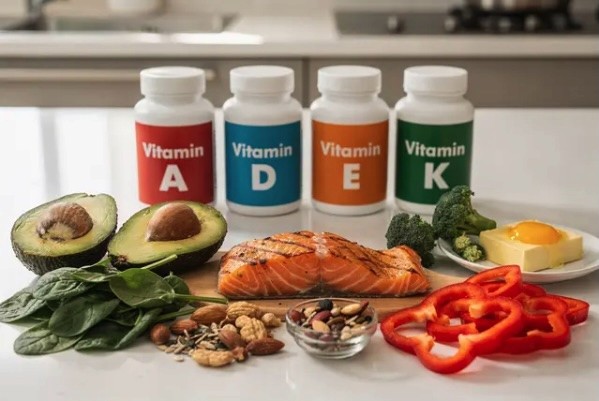
The Complete List of Fat Soluble Vitamins and What They Do
There are exactly four fat-soluble vitamins: A, D, E, and K. Unlike water-soluble vitamins, these four dissolve in fats and oils rather than water. They're absorbed alongside dietary fat in the small intestine, transported through the lymphatic system, and stored in the liver and fatty tissues for later use. That storage capacity is what makes them different from most other vitamins — and it's also what makes both their nutrition and their formulation more complex.
What Are Fat-Soluble Vitamins?
Fat-soluble vitamins dissolve in fats and oils. They don't mix with water, which means the body handles them very differently from vitamins like C or the B vitamins.
When you eat foods containing fat-soluble vitamins, those vitamins are absorbed alongside dietary fat in the small intestine. They're packaged into structures called chylomicrons and transported through the lymphatic system before entering the bloodstream. From there, they're delivered to the liver and fatty tissues for storage.
That storage is useful. It means the body can draw on reserves when dietary intake is temporarily low. But it also means excess intake can accumulate over time. Unlike water-soluble vitamins, which are largely excreted through urine, fat-soluble vitamins build up in body tissues. That's why high-dose supplementation of vitamins A and D in particular requires more care.
Why Fat-Soluble Vitamins Matter
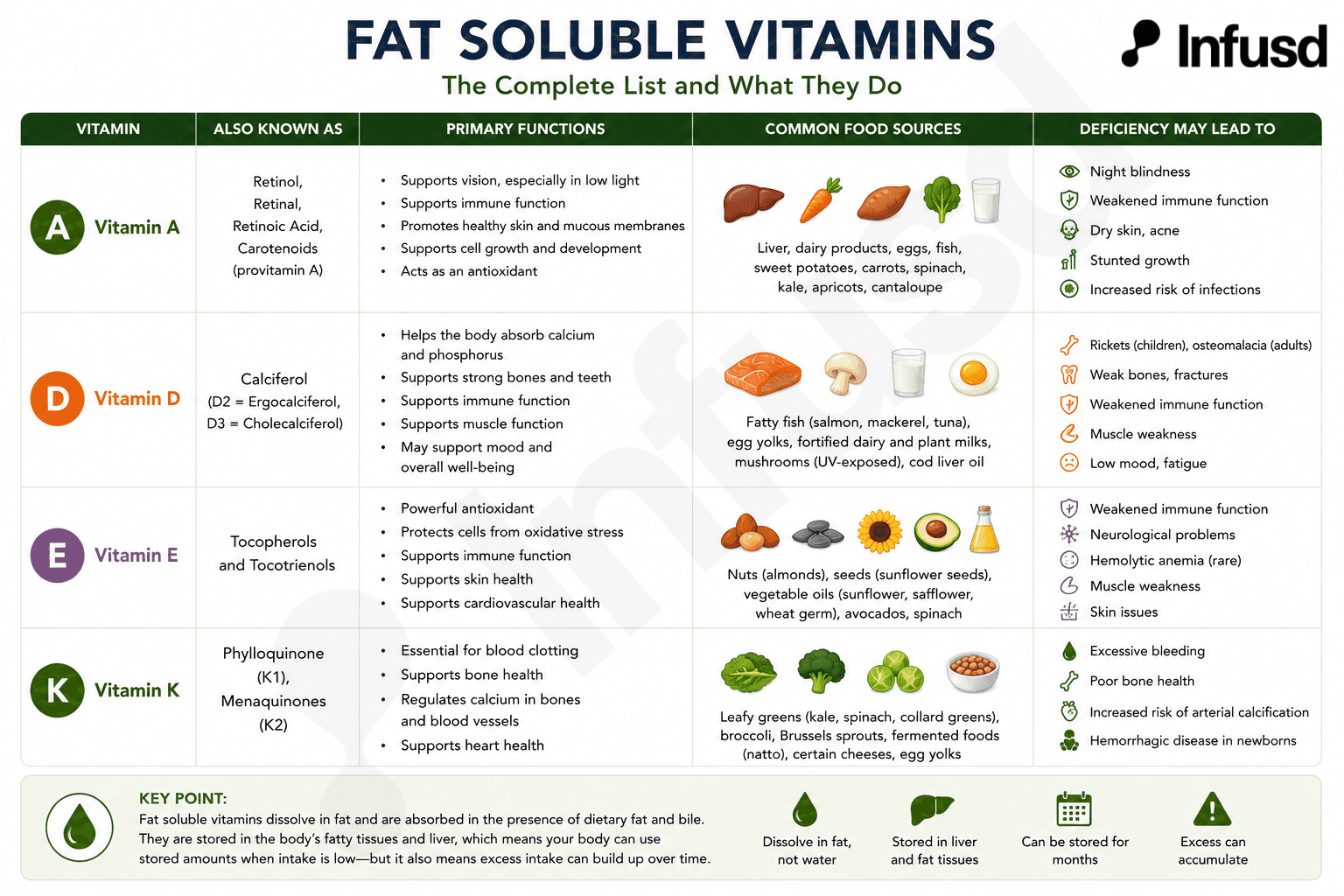
Collectively, vitamins A, D, E, and K support some of the body's most fundamental systems. Vitamin A is central to vision and immune defense. Vitamin D regulates calcium and phosphorus, making it foundational for bone and muscle health. Vitamin E acts as a key antioxidant, protecting cells from oxidative damage. Vitamin K controls blood clotting and helps direct calcium into bones rather than soft tissues.
These functions aren't isolated. Vitamins D and K, for example, work together in calcium metabolism. Vitamins A and D both influence immune responses. Getting adequate amounts of all four supports the interconnected systems that keep the body functioning well.
Vitamin A: Functions, Benefits, and Food Sources
Vitamin A supports vision, immune function, skin integrity, cell growth, and the maintenance of mucous membranes. It's involved in the production of rhodopsin, the pigment that allows the eyes to function in low light. It also plays a role in how the body produces and activates white blood cells.
Deficiency symptoms include night blindness, dry eyes, increased susceptibility to infections, and dry or scaly skin. Severe deficiency, more common in low-income countries, can lead to irreversible vision loss.
Food sources include beef liver, eggs, dairy products, fatty fish, and fortified cereals. Orange and yellow vegetables like carrots and sweet potatoes, along with dark leafy greens like spinach and kale, are also good sources via a different form of the vitamin.
Retinol vs Carotenoids
Vitamin A comes in two forms from food. Preformed vitamin A, known as retinol, is found in animal foods and is the active form the body can use directly. Provitamin A carotenoids, like beta-carotene, are plant compounds the body converts into vitamin A as needed.
The conversion isn't always efficient. Research from the Linus Pauling Institute suggests it takes around 12 micrograms of dietary beta-carotene to produce 1 microgram of retinol. In contrast, preformed vitamin A from animal sources is absorbed at roughly 75–100%. So while plant foods contribute meaningfully to vitamin A intake, animal sources tend to be more reliable for direct retinol delivery.
One practical upside to beta-carotene: the body regulates how much it converts, so it doesn't carry the same toxicity risk as high-dose preformed vitamin A.
Vitamin D: Functions, Benefits, and Food Sources
Vitamin D is best known for its role in calcium and phosphorus absorption, which makes it essential for bone density and skeletal health. It also supports muscle function, immune responses, and the reduction of inflammation. The active form of vitamin D, calcitriol, directly regulates calcium transporters in the gut and kidneys.
Food sources include fatty fish like salmon and mackerel, cod liver oil, egg yolks, and fortified dairy or plant-based milks. Sunlight is also a major contributor: the skin synthesizes vitamin D3 from UVB rays, though the amount produced depends on factors like time of day, season, and skin tone.
Because vitamin D is fat-soluble, it absorbs best when consumed with a meal containing some dietary fat. Studies show absorption is notably higher with fat-containing meals compared to fat-free ones.
Why Vitamin D Deficiency Is Common
Experts estimate that around 30–40% of the US population may be affected by vitamin D deficiency. That's a significant number, and several factors explain it.
Limited sun exposure is the biggest driver. People who work indoors, live at higher latitudes, cover their skin, or use high-SPF sunscreen consistently may not synthesize enough vitamin D from sunlight. Older adults produce less vitamin D through the skin as they age. Individuals with darker skin tones have higher melanin levels, which naturally filters UVB rays. Dietary restrictions, obesity, and conditions like Crohn's disease or celiac disease can also reduce vitamin D status.
Vitamin E: Functions, Benefits, and Food Sources
Vitamin E is primarily an antioxidant. Its main job is to neutralize free radicals — unstable molecules that can damage cell membranes, proteins, and DNA. This protective role is especially relevant in the lipid-rich environment of cell membranes, where vitamin E works to prevent oxidative damage to polyunsaturated fatty acids.
Oxidative stress occurs when free radical production outpaces the body's defenses. Over time, this imbalance is linked to increased risk of chronic disease. Vitamin E is one of the body's key defenses against it.
Beyond antioxidant activity, vitamin E also supports immune function and may help prevent abnormal blood clotting in arteries. The most biologically active form in humans is alpha-tocopherol.
Food sources include almonds, sunflower seeds, hazelnuts, wheat germ oil, sunflower oil, avocado, spinach, and broccoli. Deficiency is uncommon in healthy adults but can occur in people with fat malabsorption conditions like cystic fibrosis, pancreatitis, or celiac disease.
Vitamin K: Functions, Benefits, and Food Sources
Vitamin K acts as a coenzyme for proteins involved in blood clotting and bone metabolism. It helps produce prothrombin, a clotting factor that stops bleeding after injury. It also activates osteocalcin, a protein involved in building healthy bone tissue, and Matrix Gla Protein (MGP), which helps prevent calcium from depositing in arteries and soft tissues.
Food sources include spinach, kale, broccoli, Brussels sprouts, soybean oil, and canola oil. Fermented foods, certain cheeses, egg yolks, and some animal products are also relevant depending on the form.
Vitamin K1 vs Vitamin K2
Vitamin K1 (phylloquinone) is the form found in green plant foods. It's the dominant dietary form and is primarily associated with blood clotting through liver-based proteins. It's absorbed less efficiently than K2, and the body clears it relatively quickly.
Vitamin K2 (menaquinones) is found in fermented foods like natto and certain cheeses, as well as some animal products. It's more efficiently absorbed and stays active in the bloodstream longer. K2 is more closely associated with calcium regulation, bone health, and cardiovascular function. The MK-7 form, found in natto, remains active for up to 72 hours.
People taking anticoagulant medications like warfarin need to keep their vitamin K intake consistent, as changes in intake can affect how the medication works.
How Fat-Soluble Vitamins Are Absorbed
The absorption process starts during digestion. When you eat fat-containing food, the gallbladder releases bile, a digestive fluid produced by the liver that emulsifies fats — breaking them into smaller droplets so enzymes can work on them more effectively.
Fat-soluble vitamins dissolve into these fat droplets and are then incorporated into micelles. Micelles are tiny structures with a fat-compatible interior and a water-compatible exterior, which allows them to travel through the watery environment of the gut and reach the intestinal wall. There, the vitamins are absorbed into intestinal cells called enterocytes.
Inside the enterocytes, fat-soluble vitamins are packaged into chylomicrons — large lipoprotein particles — and released into the lymphatic system. They travel through the lymph before entering the bloodstream via the thoracic duct, eventually reaching the liver and fatty tissues for storage and use.
This is fundamentally different from how water-soluble vitamins are absorbed, which move directly into the bloodstream from the intestine without needing fat or lymphatic transport.
Why Taking Them With Food Can Help
Because fat-soluble vitamins depend on dietary fat to form micelles and get absorbed, taking them with a fat-containing meal makes a real difference. Even a modest amount of fat helps.
Practical examples: eggs with avocado, a spinach salad with olive oil dressing, roasted sweet potatoes with a drizzle of oil, or yogurt with a handful of nuts. These combinations support better absorption of vitamins A, D, E, and K compared to taking them on an empty stomach or with a fat-free meal.
What Happens If You Don't Absorb Fat Properly?
Conditions that impair fat digestion or absorption can significantly reduce how much of these vitamins the body takes in. If fat isn't properly broken down and absorbed, fat-soluble vitamins pass through the gut without being absorbed effectively.
Conditions that may affect fat-soluble vitamin status include celiac disease, Crohn's disease, ulcerative colitis, chronic pancreatitis, cystic fibrosis, gallbladder disorders, liver disease, and bariatric surgery or intestinal resection. Very low-fat diets can also reduce absorption. Certain medications, including orlistat, cholestyramine, and some antiepileptic drugs, may interfere with fat-soluble vitamin absorption as well.
People in these situations may have higher deficiency risk and should seek professional nutrition or medical guidance.
Signs That May Suggest Poor Fat-Soluble Vitamin Status
Possible signs include difficulty seeing in low light (vitamin A), bone pain or weakness (vitamin D), muscle issues or neurological symptoms (vitamin E), and easy bruising or slow wound healing (vitamin K). These are broad indicators, not diagnostic criteria. Anyone experiencing these symptoms should speak with a healthcare professional rather than self-diagnosing.
Can You Take Too Much Fat-Soluble Vitamins?
Yes, and it's worth taking seriously. Because fat-soluble vitamins are stored in the liver and fatty tissues rather than excreted in urine, they can accumulate with excessive intake over time.
Vitamin A toxicity (hypervitaminosis A) is the most commonly reported form. It's most often caused by high-dose supplements or medications containing retinol derivatives. Taking large amounts during pregnancy is particularly risky, as excess vitamin A can cause birth defects. The upper limit for preformed vitamin A is set at 3,000 mcg RAE per day.
Vitamin D toxicity from sun exposure alone is essentially impossible, as the skin regulates its own synthesis. But excessive supplementation can cause hypercalcemia — abnormally high calcium levels — with symptoms including confusion, nausea, kidney problems, and dehydration. Elevated levels can persist for weeks after stopping supplements. Most guidance recommends not exceeding 4,000 IU per day without medical supervision.
Vitamin E and K toxicities are less common, but high-dose vitamin E can interfere with vitamin K's role in blood clotting. People on anticoagulant medications need to be especially careful with both.
Why Storage Changes Supplementation Risk
Water-soluble vitamins are generally flushed out through urine when intake exceeds what the body needs. Fat-soluble vitamins don't have that safety valve. They accumulate in tissues, and the body can't easily clear them once levels get too high. This doesn't make fat-soluble vitamins unsafe — they're essential nutrients — but it does mean long-term high-dose supplementation should be approached with care and ideally guided by a healthcare professional.
Fat-Soluble vs Water-Soluble Vitamins
The core distinction is simple: fat-soluble vitamins dissolve in fat and are stored in the body. Water-soluble vitamins dissolve in water and are generally excreted more readily. That difference shapes how each type is absorbed, how often it needs to be consumed, and how much risk comes with excess intake.
Key Differences in Absorption, Storage, and Excretion
FeatureFat-Soluble (A, D, E, K)Water-Soluble (C, B vitamins)
Dissolves in
Fats and oils
Water
Absorption route
Lymphatic system with dietary fat
Directly into bloodstream
Storage
Liver and fatty tissues
Minimal; excess excreted
Excretion
Slow; primarily fecal
Rapid; primarily urinary
Toxicity risk
Higher with excess intake
Generally lower
Intake frequency
Less critical day-to-day
More regular intake needed
Why Fat-Soluble Vitamins Are Challenging in Supplements and Beverages
Adding vitamins A, D, E, or K to water-based products is genuinely difficult. These vitamins don't mix with water. In a functional beverage or liquid supplement, they tend to separate, float as an oil layer, or sediment at the bottom. That's a problem for both product appearance and nutrient delivery.
Oxidation is another issue. Fat-soluble vitamins contain unsaturated bonds and reactive groups that break down under heat, light, oxygen, and alkaline conditions. Without proper protection, potency degrades during manufacturing, storage, or processing steps like pasteurization.
Bioavailability is also affected by formulation quality. A vitamin D3 ingredient that separates in a beverage or degrades on the shelf isn't delivering the dose shown on the label. Getting the nutrient into the product is only part of the challenge — keeping it stable and bioavailable through to consumption is the other part.
The Role of Modern Delivery Systems
Emulsification and water-dispersible technologies have changed what's possible. Research suggests nanoemulsions were used in 30–75% of new beverage product launches by the early 2020s, driven by the need to incorporate lipophilic ingredients like fat-soluble vitamins into clear, stable liquid formats.
Nanoemulsions work by reducing fat droplet size to the nanoscale, which improves stability, prevents separation, and can enhance bioavailability by increasing the surface area available for absorption. At droplet sizes below 50 nm, they can even remain optically clear — useful for transparent beverages where visible oil droplets would be unacceptable.
At Infusd, our technology converts fat-soluble and insoluble ingredients into high-potency, water-soluble forms using a proprietary physical processing method and natural stabilizers — no harsh chemicals or synthetic emulsifiers. The result is ingredients that dissolve seamlessly in water, remain stable through pasteurization and carbonation, and maintain a 24-month shelf life. We work with vitamins A, D, E, and K alongside Omega-3s, botanicals, and other hard-to-formulate actives.
Supplementation Considerations for Fat-Soluble Vitamins
For consumers, the key variables are dosage, form, meal timing, and digestive function. Taking fat-soluble vitamins with a fat-containing meal improves absorption. Choosing well-formulated supplements — particularly for vitamin D, where water-dispersible forms can outperform standard oil-based capsules in certain contexts — can also make a difference. Anyone with a digestive condition or taking medications that affect fat absorption should get professional guidance before supplementing.
For Product Developers and Brands
From a formulation standpoint, fat-soluble vitamins present a specific set of demands. Active ingredient payload, shelf stability, sensory neutrality, and compatibility with processing conditions like pasteurization or carbonation all need to be considered. A vitamin D ingredient that works well in a softgel may behave very differently in an RTD beverage or a stick pack powder.
Brands developing functional products need to evaluate both the nutritional function of the vitamin and the delivery performance of the ingredient format. Clean-label expectations add another layer: many brands want to avoid synthetic emulsifiers or harsh chemical processing, which limits which delivery technologies are viable. Our ingredients are available in both liquid and powder formats, designed for gummies, RTD beverages, stick packs, single shots, and fortified foods — with clean-label formulations that work across a wide range of applications.
Frequently Asked Questions
What are the 4 fat-soluble vitamins?
The four fat-soluble vitamins are Vitamin A, Vitamin D, Vitamin E, and Vitamin K.
Which vitamins are fat-soluble?
Vitamins A, D, E, and K are fat-soluble. They dissolve in fat rather than water and are stored in the liver and fatty tissues.
Is Vitamin D fat-soluble?
Yes. Vitamin D is fat-soluble and absorbs best when consumed with a meal containing dietary fat.
Why are fat-soluble vitamins stored in the body?
Because they dissolve in fat, the body can store them in fatty tissues and the liver rather than excreting them in urine. This allows the body to draw on reserves when dietary intake is temporarily low.
Can you take too much Vitamin A or D?
Yes. Excessive intake of preformed Vitamin A or high-dose Vitamin D supplements can be harmful over time. Both accumulate in body tissues. High-dose or long-term supplementation should be guided by a healthcare professional.
What foods contain fat-soluble vitamins?
Good sources include liver, eggs, dairy, and fatty fish (Vitamin A and D), nuts, seeds, vegetable oils, and avocado (Vitamin E), and leafy greens, fermented foods, and certain cheeses (Vitamin K).
Do fat-soluble vitamins need fat for absorption?
Yes. Dietary fat is needed to form the micelles that carry fat-soluble vitamins through the gut wall. Taking them with a fat-containing meal improves absorption.
What is the difference between fat-soluble and water-soluble vitamins?
Fat-soluble vitamins dissolve in fat, are absorbed via the lymphatic system, and are stored in body tissues. Water-soluble vitamins dissolve in water, absorb directly into the bloodstream, and are generally excreted more readily through urine.
Why are fat-soluble vitamins difficult to formulate in beverages?
Water-based beverages can't naturally hold fat-soluble compounds. Without appropriate delivery technology, fat-soluble vitamins tend to separate, oxidize, sediment, or fail to disperse evenly — affecting both product appearance and nutrient delivery.
Building Better Nutrition Starts With Better Delivery
The list of fat-soluble vitamins is short — just A, D, E, and K — but their combined impact on health is significant. They support vision, immunity, bone strength, antioxidant defense, blood clotting, and calcium regulation. Getting enough of each matters, and so does how well the body can absorb and use them.
Absorption depends on dietary fat, bile function, and digestive health. For people with conditions that impair fat digestion, or for products that need to deliver these nutrients in water-based formats, the challenge goes beyond just including the right vitamin at the right dose.
For food, beverage, and wellness brands, formulation science is where nutrition intent meets real-world performance. Fat-soluble nutrients need to remain stable, dispersible, and bioavailable through manufacturing, shelf life, and consumption. That requires delivery systems built specifically for the challenge.
If your team is working with fat-soluble or hard-to-solubilize ingredients and needs clean-label, stable, water-dispersible formats for beverages, powders, gummies, or fortified foods, explore how our technology supports functional product development — or see how we've applied it to vitamin D specifically.