How to Drink Creatine: Mixes, Formats, and Timing Tips
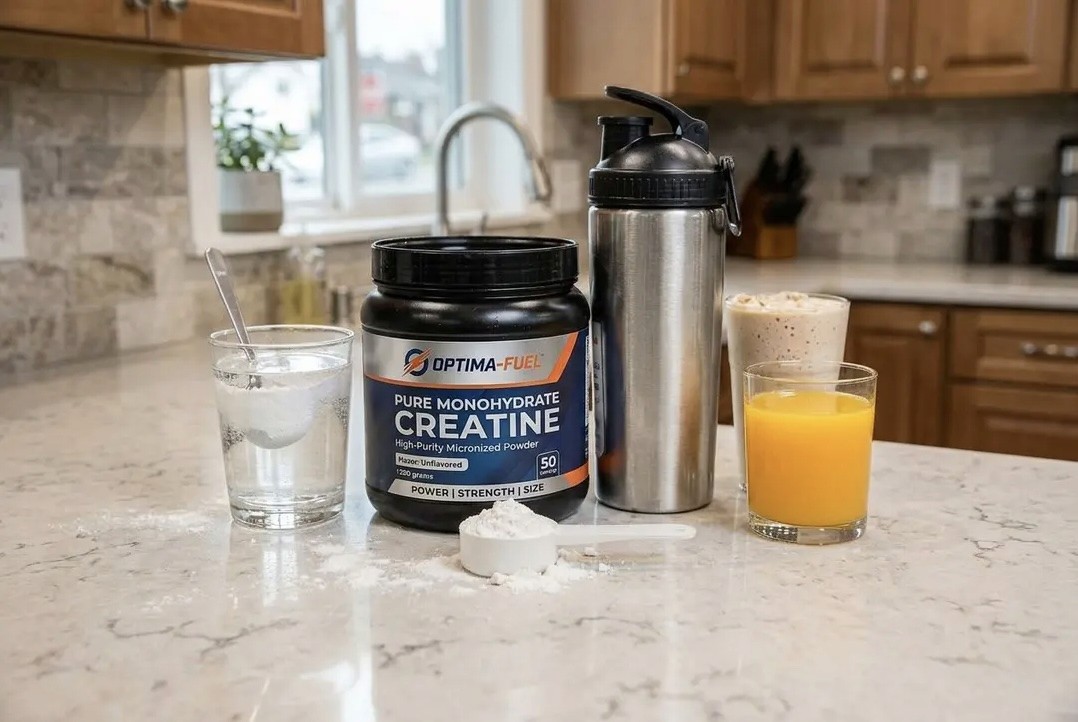
The simplest way to drink creatine is to mix 3–5 grams with 8–12 ounces of water or another beverage, shake or stir well, and drink it soon after mixing. That's it. Creatine doesn't need a complicated ritual, a specific liquid, or perfect timing. What actually determines whether it works is the dose you take and how consistently you take it. Liquid choice, temperature, and format affect the experience, not the outcome. This guide covers all of it so you can build a routine that actually sticks.
The Short Answer: Mix 3–5 Grams With 8–12 Ounces of Liquid
A standard daily creatine serving is 3–5 grams. Most people can mix that with 8–12 ounces of water or another beverage. If the texture feels gritty, use more liquid. A shaker bottle works better than a spoon. Drink it soon after mixing so less product settles at the bottom of the glass.
Creatine works by building up in your muscles over time. It's not a stimulant. One slightly imperfect drink won't undo anything. The simple version:
Dose: 3–5 grams
Liquid: 8–12 ounces
Timing: flexible
Consistency: most important
What Can You Drink Creatine With?
Creatine can be mixed with water, juice, protein shakes, smoothies, coffee, tea, sports drinks, and pre-workout. The "best" option is whichever one you'll actually repeat every day. Taste, texture, calories, caffeine tolerance, and convenience all factor in.
One thing worth checking before mixing creatine into pre-workout: some pre-workouts already contain creatine. Others include it but at less than a full daily dose. Read the label before stacking.
How to Drink Creatine With Water
Water is the most common way to take creatine. It's low-calorie, neutral, and easy to use daily. Add 3–5 grams to 8–12 ounces of water, shake or stir well, and drink it. That's the baseline.
Some creatine will settle if the drink sits for a few minutes. Shake it again or just drink it promptly. If the texture feels gritty, use more water or switch to a shaker bottle. Water isn't the only option, but it's the easiest starting point when figuring out how to drink creatine.
How to Drink Creatine With Juice
Juice works well if you want something that tastes better than plain water. Orange, grape, and apple juice are all fine. The acidity in juice can also help suspend creatine in solution, which may reduce visible sediment slightly.
The tradeoff is sugar and calories. If that fits your goals, juice is a solid option. But it's not required for creatine to work. The benefit is taste and routine compliance, not absorption.
How to Drink Creatine in a Protein Shake
Creatine mixes well into a protein shake, and it's one of the more practical options for people who already drink one daily. You're combining two habits into one, which makes consistency easier.
Creatine and protein do different things. Protein supports amino acid intake and muscle repair. Creatine supports muscle creatine stores over time. Combining them in one drink doesn't make either work faster. The shake just makes the routine simpler.
When mixing two powders, texture can get thicker or grittier. Use enough liquid and shake or blend thoroughly. If you're blending, a full blender pass usually handles the texture better than a shaker bottle alone.
How to Drink Creatine in a Smoothie
Smoothies are one of the better options if you're sensitive to gritty texture. Fruit, yogurt, milk, plant milk, nut butter, and oats all change the mouthfeel in ways that mask creatine's texture more effectively than thin drinks.
Smoothies work well as part of a meal or snack. The main thing to remember: drink the full serving. Creatine can settle at the bottom of a thick smoothie, so blend well and don't leave the last inch in the glass.
Can You Drink Creatine in Coffee or Tea?
Yes. Creatine can be added to coffee or tea and consumed soon after mixing. Normal hot beverage use doesn't instantly destroy creatine. The concern is leaving creatine sitting in hot, acidic liquid for extended periods, which can accelerate degradation. Mix it in and drink it.
Add creatine after brewing rather than boiling it directly. If the drink is very hot, let it cool for a minute first. For coffee specifically, pay attention to how your stomach handles the caffeine-creatine combination. Some people experience discomfort. Tea tends to be gentler for those who find coffee too harsh.
Can You Drink Creatine With Pre-Workout?
You can, but check the label first. Some pre-workouts already contain creatine, sometimes at a full dose, sometimes less. If yours has 1–2 grams, you may want to add more to reach the effective 3–5 gram range.
Also check total caffeine. Pre-workouts can be heavily caffeinated, and stacking creatine on top doesn't change that. Creatine doesn't need to be taken before training specifically. If pre-workout causes stomach discomfort, take creatine separately at a different time of day.
Should You Drink Creatine Before or After a Workout?
Either works. Creatine is not a stimulant. It doesn't give you an immediate kick like caffeine. It works by gradually increasing the creatine stored in your muscles over days and weeks, so the exact window around your workout matters less than people think.
Research on creatine timing is limited and mixed. Some studies suggest post-workout may have a slight edge, but the differences become statistically small across longer timeframes. The best timing is whichever one you can repeat consistently. If you already drink a shake after training, add creatine to that. If mornings work better, take it then.
Should You Drink Creatine Every Day?
Yes. Daily use keeps muscle creatine stores topped up. A typical maintenance serving is 3–5 grams per day. Skipping an occasional day isn't a disaster, but consistency is the point.
If you have kidney disease, are pregnant or breastfeeding, take medications, or have any other health concerns, talk to a healthcare professional before starting creatine. For healthy adults, more than 20 years of research has not demonstrated adverse effects on kidney health at recommended doses.
Do You Need a Creatine Loading Phase?
No. Loading means taking around 20 grams per day split into four or five servings for 5–7 days to saturate muscles faster. It works, but it's not required. Taking 3–5 grams daily without loading reaches the same level of muscle saturation, just over about three to four weeks instead of one.
Loading increases the chance of stomach discomfort for some people. If you do load, split the servings throughout the day, take each one with fluid, and follow the product directions. If you skip loading, just start with the daily maintenance dose and stay consistent.
Does Creatine Need to Fully Dissolve?
Not always, and this is where the drinking experience gets more nuanced. Creatine monohydrate has relatively low solubility in cold water, around 14 grams per liter at room temperature. A standard 5-gram serving in 250 mL of cold water will likely leave some undissolved particles.
Dissolving, dispersing, suspending, and mixing are not the same thing. Creatine that hasn't fully dissolved can still disperse through the liquid and remain bioavailable. But if it settles at the bottom and you don't drink the full glass, you're leaving part of your dose behind.
Micronized creatine uses smaller particles that stay suspended in liquid longer, which reduces visible sediment and improves texture. It doesn't change the underlying chemistry or make creatine more effective at the same dose, but it does make the drink more pleasant. As we explain in our micronized creatine vs creatine monohydrate article, micronization changes particle size and user experience, not the active ingredient itself.
Smoothness depends on particle size, dose, liquid volume, temperature, agitation, and the beverage matrix. That's why the same creatine can feel completely different in cold water versus a warm protein shake.
How to Avoid Grit, Clumps, and Sediment
Add liquid to the glass or shaker first, then add creatine
Use at least 8–12 ounces of liquid
Use a shaker bottle rather than just a spoon
Use a blender for smoothies and protein shakes
Try slightly warmer liquid if cold water leaves too much residue
Drink soon after mixing before sediment forms
Shake or stir again if the drink sits for a few minutes
Choose a format that matches your texture preference
Don't assume every creatine product will mix the same way
As we cover in our guide on how much water to use with creatine, undissolved particles are still bioavailable. Grit doesn't mean the product isn't working. But swirling and drinking the sediment matters if you want the full dose.
Can You Dry Scoop Creatine?
No. Dry scooping creatine is not recommended. It's unnecessary, unpleasant, and harder to swallow. It creates a choking risk and can irritate your esophagus. It doesn't make creatine work better or faster. Creatine's benefits come from consistent daily intake, not from how quickly you get the powder down.
The goal is a comfortable routine you can repeat every day. Dry scooping works against that.
How Much Water Should You Drink With Creatine?
Start with 8–12 ounces per serving. That's a practical baseline, not a hard rule. More water can make the drink smoother and easier on the stomach. Less is fine if you tolerate it, but expect more grit and sediment.
Daily hydration needs depend on body size, activity level, sweat rate, climate, and diet. Active people training in heat need more fluids regardless of creatine. But there's no universal rule that creatine users must drink a gallon of water a day. More water improves the drinking experience. It doesn't change the dose or increase how much creatine reaches your muscles.
Product Format Matters: Powders, Gummies, Gels, Chews, Capsules, and RTDs
Creatine is no longer just a powder you stir into water. Consumers now use powders, stick packs, gummies, gels, chews, capsules, shots, ready-to-drink products, and hybrid creatine/pre-workout or creatine/protein products. Each format changes the experience.
Powders are flexible and cost-effective but require mixing. Stick packs are convenient but still depend on liquid volume and taste. Gummies and chews remove the need to drink creatine entirely, but serving size, sugar content, and dose accuracy matter. As we cover in our creatine gummies vs powder article, a 2025 analysis found many gummy products contained less creatine than their labels claimed, which is a formulation and quality control problem.
Capsules are simple but may require four or more pills to reach a 5-gram dose. Shots are portable but need careful management of concentration, flavor, and mouthfeel in a small volume. RTDs are convenient but require significant formulation work around stability, sediment, pH, flavor, and label accuracy. Creatine monohydrate can degrade into creatinine in water over time, especially at higher temperatures or lower pH, which makes RTD formulation genuinely challenging.
The best format is the one that delivers a meaningful dose and fits the user's daily routine. Powder still dominates with around 57% market share, but premium gummy and RTD formats are generating approximately 21% higher per-user spending, which signals real consumer demand for more convenient delivery.
For Brands: Why "How to Drink Creatine" Is Really a Delivery Problem
When consumers ask how to drink creatine, they're often asking something deeper: how do I make this easier to take every day? Grittiness, sediment, chalky taste, inconsistent texture, and awkward serving sizes are not user errors. They're product experience problems.
Creatine works best when people take it consistently. So if a product is unpleasant to drink, inconvenient to prepare, or leaves half the dose at the bottom of the glass, that's a formulation problem with real compliance consequences.
Brands developing creatine products need to think through dose load, solubility, dispersion, liquid volume, mouthfeel, sweetness, acidity, flavor masking, and stability across the full shelf life. RTDs, gels, shots, gummies, chews, and powders each create different challenges. A product can contain the right ingredient at the right dose and still fail if the texture, taste, or stability undermines daily use.
At Infusd, this is something we work on directly. We transform hard-to-formulate ingredients like creatine into stable, water-soluble formats that dissolve seamlessly with minimal agitation, rather than leaving gritty residue or settling at the bottom. Our ingredient technology uses a proprietary physical processing method and natural stabilizers to deliver high active payloads, enhanced bioavailability, and long-term shelf stability, including through pasteurization and carbonation. The goal is to make the product experience match the dose on the label.
Best Practices for Drinking Creatine
Use 3–5 grams per day unless the product label says otherwise
Mix powder with 8–12 ounces of water or another beverage
Shake, stir, or blend thoroughly
Drink soon after mixing
Shake again if sediment forms before you finish the drink
Take creatine daily for consistency
Choose a drink or format that fits your actual routine
Don't dry scoop
Don't assume more creatine is better
Don't assume more water makes creatine more effective
If you have kidney disease, are pregnant, take medications, or have a medical condition, ask a healthcare professional before using creatine
Quick Comparison: Best Drinks for Creatine
Water — Yes, you can mix creatine with it. Best for simple daily use. Watch out for plain taste and possible grit.
Juice — Yes. Best for better flavor. Adds sugar and calories.
Protein shake — Yes. Best for combining habits. Can become thick or gritty; use enough liquid.
Smoothie — Yes. Best for masking texture. Must drink the full serving to get the full dose.
Coffee — Yes. Best for morning routines. Caffeine tolerance and stomach comfort matter; drink soon after mixing.
Tea — Yes. Best as a gentler hot drink option. Add creatine after brewing, not during.
Sports drink — Yes. Best around training sessions. Check sugar and electrolyte content.
Pre-workout — Yes. Best for pre-training routines. Check existing creatine and caffeine levels first.
RTD shake — Sometimes. Best for convenience. May have mixing or stability issues depending on formulation.
Frequently Asked Questions
How do you drink creatine?
Mix 3–5 grams with 8–12 ounces of water or another beverage, shake or stir well, and drink it soon after mixing.
What is the best drink to mix creatine with?
Water is the simplest option. But juice, protein shakes, smoothies, coffee, tea, sports drinks, and pre-workout can all work depending on taste, texture, and routine.
Can I drink creatine with water?
Yes. Water is the most common and straightforward way to take creatine.
Can I drink creatine with juice?
Yes. Juice can improve taste, but it adds sugar and calories. It's not required for creatine to work.
Can I drink creatine with coffee?
Yes. Mix creatine into coffee and drink it soon after. Pay attention to caffeine tolerance and stomach comfort, and don't let it sit in hot coffee for a long time.
Can I drink creatine with tea?
Yes. Add creatine after brewing. Let very hot tea cool slightly before mixing, and drink it promptly.
Can I put creatine in a protein shake?
Yes. Creatine mixes well into a protein shake. It's a convenient option for people who already use protein daily.
Should I drink creatine before or after a workout?
Either works. Consistency matters more than exact timing. Creatine is not a stimulant and doesn't provide an immediate effect like caffeine.
Should I drink creatine every day?
Yes. Daily use helps maintain muscle creatine stores. Follow the serving size on the product label.
Does creatine need to fully dissolve?
Not always. Creatine may not fully dissolve and can settle at the bottom of the glass. Shake or stir well and drink the full serving to get the full dose.
Can I dry scoop creatine?
No. Dry scooping is not recommended. It's unnecessary, unpleasant, and doesn't make creatine work better.
How much water should I drink with creatine?
Start with 8–12 ounces per serving. Daily hydration needs vary by body size, activity level, sweat rate, climate, and diet.
Can I drink creatine in a smoothie?
Yes. Smoothies can mask creatine's texture well. Blend thoroughly and drink the full serving.
What should brands know about creatine drink formats?
Brands need to think through dose, taste, texture, sediment, solubility, dispersion, liquid volume, stability, and whether the final format supports consistent daily use. A product that's unpleasant to drink or inconsistent in dose won't perform, regardless of what's on the label.
The Best Creatine Routine Is the One People Actually Use
The best way to drink creatine is to mix 3–5 grams with 8–12 ounces of water or another beverage, shake or stir well, and drink it soon after mixing. Water is the simplest option. Juice, protein shakes, smoothies, coffee, tea, sports drinks, and pre-workout can all work depending on preference and routine.
Creatine doesn't need perfect timing or a complicated ritual. It needs a meaningful dose, a format that feels good to use, and consistent daily intake. The details around liquid type, temperature, and texture matter for the experience, not for whether creatine works.
For brands developing creatine beverages, shots, gels, gummies, powders, or other delivery formats, those details become formulation problems. Getting the dose right on the label is one thing. Getting it into a product that people actually want to use every day is another. Our ingredient solutions are built around exactly that challenge, helping brands create cleaner, more stable, more user-friendly creatine formats across the full range of delivery applications.