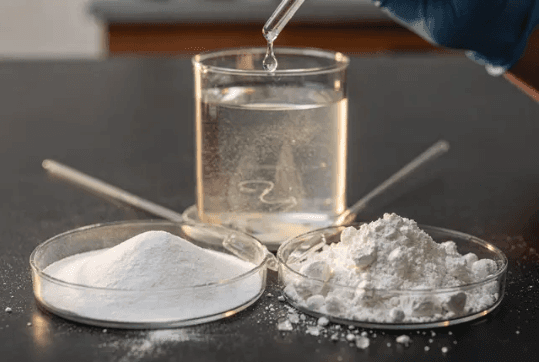
Micronized Creatine vs Creatine Monohydrate: What Changes?
Micronized creatine is usually creatine monohydrate that has been mechanically processed into smaller particles. It is not a separate type of creatine. Micronization may improve how creatine mixes, feels in the mouth, and disperses in liquid, but it does not automatically make creatine more effective when the dose is the same. Creatine monohydrate remains the most researched form of creatine available. Micronization changes particle size and user experience, not the underlying active ingredient.
That distinction matters, and most articles on micronized creatine vs creatine monohydrate miss it entirely.
The Short Answer: Micronized Creatine Is Usually Still Creatine Monohydrate
"Creatine monohydrate" tells you what the active compound is. "Micronized" tells you how the particles were processed. These are two different dimensions of the same ingredient, not two competing products.
When you see "micronized creatine" on a label, it almost always means micronized creatine monohydrate. The micronization process breaks standard creatine particles down into pieces that are typically around 20 times smaller than regular creatine. The chemical structure of creatine itself does not change.
If both products deliver 3–5 grams of creatine monohydrate per day, the expected performance benefits should be similar. The main differences are practical: smoother texture, less grit, and better dispersion in liquid.
Creatine Monohydrate: The Gold Standard
Creatine monohydrate is the most studied supplement in sports nutrition. Over 680 peer-reviewed clinical trials have been conducted on creatine supplementation, the vast majority using creatine monohydrate. The International Society of Sports Nutrition calls it "the most effective ergogenic nutritional supplement currently available to athletes."
It works by increasing muscle creatine stores over time, which supports high-intensity exercise capacity and lean mass during training. Short-term loading can increase intramuscular creatine stores by 20–40% and exercise performance capacity by 5–10%.
Standard dosing is straightforward. A maintenance dose of 3–5 grams daily is the most common evidence-based recommendation. Loading at 20 grams per day for 5–7 days is optional and saturates muscle stores faster, but taking 3–5 grams daily for around 30 days achieves the same result. Consistency matters more than timing or format.
The Gatorade Sports Science Institute states clearly: "There are no data indicating that other available forms of creatine are more effective." Creatine monohydrate is also FDA GRAS-classified at levels up to 5 grams per serving.
What Does "Micronized Creatine" Mean?
Micronization is a particle-size reduction process. It uses high-pressure air jet mills or mechanical mills to break solid material into smaller particles, typically below 10 microns in diameter. The goal is usually better dispersion, easier mixing, and smoother texture in the final product.
Standard creatine monohydrate is typically 80 mesh. Micronized creatine is typically 200 mesh, with some ultra-micronized grades going to 500 mesh or higher. Finer mesh means smaller particles and faster dispersion, but it also means lower bulk density and potential clumping during manufacturing.
The key point: monohydrate tells you what the creatine is. Micronized tells you how the particles were processed.
Micronized Creatine vs Creatine Monohydrate: Quick Comparison
Here is a straightforward look at how the two compare across the factors that actually matter:
Factor | Creatine Monohydrate | Micronized Creatine | Practical Winner |
|---|---|---|---|
Active ingredient | Creatine monohydrate | Usually creatine monohydrate | Same |
Research support | Extensive (680+ trials) | Relies on monohydrate research | Creatine monohydrate |
Effectiveness | Well established | Same if dose matches | Tie (equal dose) |
Mixability | Can be slow to dissolve | Disperses more easily | Micronized |
Texture/mouthfeel | Can feel gritty or sandy | Smooth, non-gritty | Micronized |
Solubility | ~13–14 g/L at 20°C | Similar limit, faster dispersion | Neither (same limit) |
Absorption claims | ~99% at standard doses | No proven advantage | Creatine monohydrate |
Cost | Lower | Slightly higher | Standard monohydrate |
Best use case | Capsules, simple powders, shakes | Premium powders, beverages, gummies | Format-dependent |
Product development | Good flow for manufacturing | Better sensory, more complex to handle | Depends on format |
Is Micronized Creatine More Effective?
No, not necessarily. Creatine works by accumulating in muscle tissue over time. That process depends on how much creatine you consume consistently, not on how quickly it disperses in a glass of water.
If standard creatine monohydrate and micronized creatine monohydrate both deliver the same usable daily dose, the expected strength, muscle, and performance benefits should be similar. Healthline puts it plainly: "Despite these minor differences in processing, each of these forms is likely equally effective when equal doses are given."
Micronized creatine may improve the experience of taking creatine, particularly in liquid formats. But the evidence does not support treating it as categorically superior for performance outcomes.
Does Micronized Creatine Absorb Better?
This is where marketing language often gets ahead of the evidence. Smaller particles do mean more surface area, which can improve how quickly creatine disperses in liquid. But dispersion is not the same as absorption.
Standard creatine monohydrate already has bioavailability of approximately 99% at standard doses of 5–10 grams. When absorption is already that high, there is limited room for micronization to make a meaningful clinical difference. As Transparent Labs notes, the increased surface area "should theoretically increase the rate of absorption, but this probably doesn't make a big difference since creatine supplementation is most beneficial over extended periods."
Absorption and effectiveness depend on the amount of creatine delivered and consumed consistently. A smoother-mixing powder is not automatically more bioavailable in any meaningful way.
Solubility vs. Mixability: The Difference Most Articles Miss
These two terms are not interchangeable, and confusing them leads to a lot of misleading supplement marketing.
Solubility is how much of a substance can actually dissolve in a liquid. As we explain in our piece on what solubility means in supplement science, it is "the ability of a substance to dissolve in a solvent and form a uniform mixture," and it is shaped by temperature, pressure, molecular structure, and particle size.
Mixability or dispersibility is how evenly particles spread through a liquid. A powder can appear to mix better without truly becoming more soluble.
Creatine monohydrate has a solubility of around 13–14 g/L at 20°C. Micronization increases surface area, which speeds up how quickly particles disperse and reduces grittiness. But it does not dramatically shift that fundamental solubility ceiling. Micronized creatine may suspend better in liquid, but that is not the same as being infinitely soluble.
Why This Matters for Drinks, Shots, Gels, and RTD Products
In finished products, this distinction becomes very practical. Poorly dispersed creatine can settle to the bottom of a beverage, create a gritty texture, cause visible particles, and lead to uneven dosing across servings. As we cover in our article on what makes a functional drink actually functional, presence in a product is not the same as absorption. If an ingredient cannot dissolve adequately in the digestive environment, the body may absorb only a fraction of it.
For RTD beverages, there is an additional problem: creatine monohydrate can degrade into creatinine in water over time, especially at higher temperatures or lower pH. Creatinine offers no ergogenic benefit. In a neutral pH RTD, approximately 95% of standard creatine monohydrate has already converted to creatinine after three months, with complete degradation by 12 months. Micronization alone does not solve this. Stability in liquid formats requires a different approach entirely.
Why Particle Size Matters in Real Products
Particle size has real consequences in finished product design, even when it does not change the active ingredient. It affects mouthfeel, grittiness, sedimentation, suspension, visual appearance, mixing speed, manufacturing consistency, and dose uniformity.
These factors matter more in product development than in abstract comparisons of "which creatine is stronger." The right particle size depends entirely on the format:
Gummies: Ultra-micronized creatine (500 mesh or higher) is described as grit-free at up to 1.5 grams per gummy. Standard creatine is generally not recommended for gummies due to grittiness.
Stick packs: Granular creatine (20–80 mesh) flows better through automated filling equipment, reducing clumping and production issues. Finer grades can cause manufacturing headaches.
Premium powders and blends: 200 mesh micronized creatine is often considered essential for smooth texture and even distribution.
Capsules and tablets: Standard mesh sizes (40–80 mesh) work well and keep costs down.
RTD beverages and shots: Particle size is only one variable. Stability, pH, water activity, and encapsulation matter far more for shelf-life performance.
As we note in our solubility explainer, "the same active ingredient can behave very differently depending on how it's delivered." Format shapes everything.
When Micronized Creatine Makes Sense
Micronized creatine is a practical choice in several situations:
Consumers who find standard creatine gritty or unpleasant to drink
Products designed to mix quickly in water with minimal agitation
Single-serve stick packs where texture consistency matters
Functional beverages where mouthfeel is a key part of the product experience
Chews, gels, and hybrid formats where particle distribution affects texture
Brands improving user experience without changing the active ingredient or dose
The main benefit is a better product or user experience. That is a legitimate reason to choose micronized creatine, as long as the claims stay honest about what micronization actually does.
When Regular Creatine Monohydrate Is Enough
Standard creatine monohydrate is not inferior simply because it is not micronized. It remains the most cost-effective, most researched option available. It makes sense for:
Cost-conscious consumers who want the most evidence-backed option at the lowest price
Athletes who already mix creatine into shakes or smoothies where texture is less noticeable
Brands making simple, no-frills powder products where price and purity matter most
Anyone who wants the most straightforward and researched creatine option
If you tolerate standard creatine monohydrate well and you are hitting your daily dose consistently, there is no compelling performance reason to switch.
What Brands Should Know Before Choosing Micronized Creatine
Micronized creatine is not automatically the right choice for every product. Particle size is one variable in a much larger formulation picture.
For powders and stick packs, finer mesh grades disperse better but can clump during manufacturing and require larger packaging due to lower bulk density. For gummies and chews, ultra-fine grades reduce grittiness but dose uniformity and binder compatibility need to be validated in the finished product. For beverages, gels, and RTDs, particle size is almost secondary to stability, pH, water activity, flavor system compatibility, processing conditions, and shelf-life performance.
Creatine degrades into creatinine in liquid over time. Encapsulation, push-cap technology, or other delivery innovations are often more relevant to RTD stability than micronization alone. Brands should validate finished-product potency through shelf-life testing, not rely solely on ingredient specifications.
How Infusd Thinks About Functional Ingredient Delivery
Our work focuses on transforming hard-to-formulate ingredients, including creatine, into stable, water-compatible forms that perform in real product formats. We list creatine explicitly among the actives we work with on our ingredient transformation platform, alongside omega-3s, fat-soluble vitamins, curcumin, and ashwagandha.
The challenge with creatine is not just particle size. It is solubility, stability, sensory performance, and dose consistency across the shelf life of the finished product. Our technology page explains how we approach this: transforming ingredients into highly potent, water-soluble forms that dissolve seamlessly, require minimal agitation, and remain stable through pasteurization and carbonation. That is the kind of delivery thinking that matters when you are building a creatine gummy, a functional shot, or a shelf-stable RTD, not just a basic powder tub.
For brands developing formats beyond simple powders, our applications overview covers how these delivery systems apply across beverages, stick packs, gummies, and more.
What to Look for on a Creatine Label
Whether you are a consumer or a product developer evaluating a supplier, here is what to check:
Does it specify creatine monohydrate as the active ingredient?
Does it say "micronized creatine monohydrate" or only "micronized creatine"?
How many grams of creatine are in each serving?
Does the daily serving realistically deliver 3–5 grams?
Is the product third-party tested?
Are certificates of analysis available from the supplier?
Does it contain added sugars, fillers, or unnecessary ingredients?
Does it make unsupported bioavailability or absorption claims?
If a product only says "micronized creatine" without specifying the form, ask. Most of the time it is creatine monohydrate, but it is worth confirming.
Common Claims About Micronized Creatine, Explained
"Mixes instantly" — Plausible. Smaller particles do disperse more quickly and evenly. This is a legitimate benefit in powders and beverages.
"Absorbs faster" — Theoretically possible due to increased surface area, but the practical difference is likely minimal. Standard creatine monohydrate already absorbs at close to 99% at normal doses. Better dispersion does not automatically translate to meaningfully better absorption.
"No bloating" — Some users may perceive better tolerance, possibly because smoother mixing reduces the likelihood of taking a clumped or uneven dose. But micronization alone cannot be claimed to eliminate bloating for everyone.
"More soluble" — Micronization improves dispersion and reduces grit. It does not dramatically change creatine's fundamental solubility limit in water. These are different things.
"More advanced" — Micronization is a processing method. It is not a fundamentally different or superior active ingredient. Calling it "advanced" is marketing language, not a performance claim.
Which Option Is Better for Different Use Cases?
Consumers focused on price and evidence should choose standard creatine monohydrate. It is the most studied, most accessible, and most cost-effective option. If you already mix it into a shake without issues, there is no reason to pay more for micronized.
Consumers who dislike gritty powders or want a smoother experience in plain water may prefer micronized creatine monohydrate. The experience benefit is real, even if the performance difference is not.
Brands developing premium powders, gels, chews, or drink-adjacent formats should consider micronized creatine for texture and distribution. But brands developing beverages or RTDs need to think beyond particle size. Solubility, suspension, stability, pH, flavor compatibility, processing conditions, and shelf life all matter, and micronization alone does not solve those challenges.
FAQ: Micronized Creatine, Monohydrate, Solubility, and Formulation
Is micronized creatine the same as creatine monohydrate?
Usually, yes. Micronized creatine is most often creatine monohydrate that has been processed into smaller particles. Check the label to confirm the active ingredient.
Is micronized creatine better than creatine monohydrate?
It may be better for mixability and texture. It is not necessarily better for performance if the dose and active ingredient are the same.
Does micronized creatine absorb better?
Smaller particles may disperse more evenly in liquid, but better dispersion does not automatically prove meaningfully better absorption. Standard creatine monohydrate already absorbs at close to 99% at normal doses.
Is micronized creatine more soluble?
Micronization may improve dispersion and reduce grit, but it does not significantly change creatine's true solubility limit in water. Mixability and solubility are not the same thing.
Does micronized creatine work faster?
No, not in any meaningful way. Creatine benefits come from consistent daily intake and increased muscle creatine stores over time. It is not a stimulant with an immediate effect.
Is micronized creatine worth it?
It may be worth it if you value smoother mixing and less grit. Standard monohydrate is the better choice if cost matters more than texture.
What is the best form of creatine?
Creatine monohydrate remains the best-supported form overall. It has the strongest research base, the most evidence for effectiveness, and the best cost efficiency.
How much micronized creatine should I take?
Micronized creatine monohydrate follows the same evidence-based dosing as standard creatine monohydrate: typically 3–5 grams daily for maintenance. Follow product directions and consult a healthcare professional if needed.
Does micronized creatine cause less bloating?
Some users may perceive better tolerance, but micronization alone cannot be claimed to eliminate bloating for everyone. Individual responses vary.
Should brands use micronized creatine in gummies, gels, or drinks?
It depends on the format, dose, texture goals, stability requirements, and manufacturing process. Micronized creatine can improve texture in gummies and powders, but beverages and RTDs require additional stability considerations beyond particle size. Always validate the finished product through potency, sensory, and shelf-life testing.
The Practical Takeaway for Consumers and Product Teams
Creatine monohydrate is still the gold standard. It has the research, the track record, and the cost efficiency. Micronized creatine may improve mixability, texture, and finished-product experience, but it is not a different active ingredient and it is not automatically more effective.
Consumers should choose based on budget and preference. If gritty powder bothers you, micronized creatine monohydrate is a reasonable upgrade. If it does not, standard creatine monohydrate delivers the same results for less money.
Brands should choose based on product format, stability requirements, sensory goals, and delivery needs. Particle size is one lever. It is not the whole picture. For teams developing functional powders, beverages, gels, gummies, or fortified products where ingredient delivery is the hard part, our ingredient transformation work is built around exactly these challenges. We help brands get hard-to-formulate ingredients like creatine to perform in real products, not just on paper.