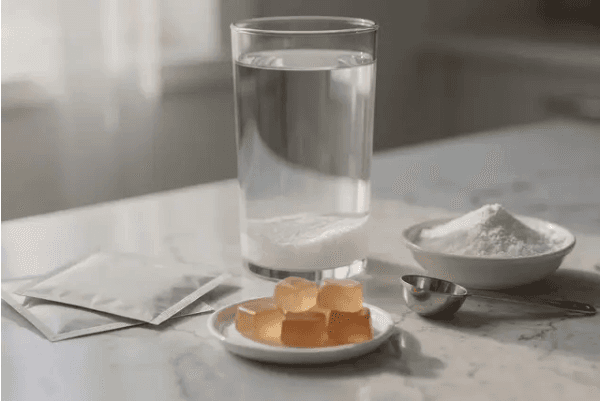
Magnesium Malate Powder: Solubility, Taste, and Product-Format Considerations
Magnesium malate powder solves three problems that recur in feedback on magnesium capsules and tablets: large pills that are difficult to swallow, fixed doses that cannot be adjusted, and digestive discomfort from poorly absorbed forms. A powder format allows the elemental magnesium dose to be set per serving, dissolves into water or other beverages, and removes the capsule shell and tablet binders from the formula entirely.
Magnesium malate itself pairs magnesium with malic acid, an intermediate of the Krebs cycle that cells use to generate ATP. This article covers what the compound is, how it behaves in water, how it tastes, what the evidence supports, and how the powder compares with capsules and with glycinate and citrate powders. It is written for product developers and R&D teams, and the practical dosing sections apply equally to anyone evaluating the ingredient.
Why Choose Powder Over Capsules?
Powder formats remove the physical constraints that capsules impose on magnesium products. The core reason is dose mass: magnesium salts carry a large amount of non-magnesium weight, so a meaningful elemental dose rarely fits in one capsule.
Supplier specifications place magnesium malate trihydrate at roughly 14.5% to 15.6% elemental magnesium and di-magnesium malate at about 20% (trihydrate specification; di-magnesium malate specification). Some trihydrate grades are specified as low as 11.5% magnesium, so the certificate of analysis governs. Delivering 200 mg of elemental magnesium therefore requires about 1,000 mg of di-magnesium malate or roughly 1,380 mg of the trihydrate. Both figures exceed what a single capsule can hold, so a full daily dose in capsule form requires multiple units or a large tablet, with the exact count depending on capsule fill capacity.
The principal advantages of a powder format are:
Customizable dosing. A scoop or stick pack can be sized to any elemental magnesium target, and consumers can halve or split a serving without opening a capsule.
Dissolution before ingestion. A powder that dissolves in water arrives in the stomach already in solution. The NIH Office of Dietary Supplements notes that forms of magnesium that dissolve well in liquid are absorbed more completely than less soluble forms.
Easy-to-mix magnesium. The same ingredient can go into water, warm tea, smoothies, or a hydration mix, which supports daily supplement routines that already involve a beverage.
No capsule shell or binders. Powders require no gelatin or HPMC shell, no flow aids for encapsulation, and no compression excipients. This matters for clean-label positioning and for vegetarian or vegan claims.
Magnesium Malate Powder vs. Capsules
The comparison below summarizes the practical differences by factor.
Absorption rate. Powder: the salt is dissolved before ingestion, so no capsule disintegration step is required. Capsules: the shell must rupture and the compressed or granulated salt must dissolve in gastric fluid before absorption begins.
Dosage control. Powder: continuously adjustable by scoop or stick-pack weight. Capsules: fixed per unit; adjustments happen in whole-capsule increments.
Swallowing ease. Powder: consumed as a drink, with no swallowing of solids. Capsules: a full daily dose usually means swallowing several units.
Convenience. Powder: requires a liquid and a moment of mixing; stick packs improve portability. Capsules: portable and require no preparation, but less flexible.
Excipients. Powder: can be formulated with only the active and a flavor system. Capsules: require a shell and often flow agents or fillers.
Capsules retain an advantage where taste masking is not feasible or where a consumer wants zero preparation. For the pill-fatigued segment described in our earlier article on pill fatigue, the powder trade-off generally favors the drinkable format.
What Magnesium Malate Actually Is
Magnesium malate is the magnesium salt of malic acid, the dicarboxylic acid that gives apples and many fruits their tartness. Commercial materials appear under several names and stoichiometries, and the differences affect formulation math and regulatory status.
Magnesium malate (often supplied as the trihydrate). Magnesium content in the mid-teens by weight. Listed as an authorised source of magnesium for food supplements in Annex II of EU Directive 2002/46/EC, as confirmed in the EFSA opinion on di-magnesium malate.
Di-magnesium malate (DMM). A higher-magnesium complex, typically specified near 20% magnesium. In the EU, EFSA concluded in 2018 that there was insufficient evidence to distinguish DMM from the already authorised magnesium malate, was unable to assess it as a separate novel food ingredient, and raised concern that the proposed use levels could push intakes above the EU upper limit for supplemental magnesium. In the United States, DMM's GRAS status rests on a supplier self-affirmation rather than an FDA GRAS notice.
Malic acid. The counter-ion is itself GRAS as a direct food substance under 21 CFR 184.1069 and is widely used as a beverage acidulant.
Supplement Facts panels declare elemental magnesium, not compound weight. A 1,000 mg serving of magnesium malate trihydrate therefore labels as roughly 145 to 156 mg of magnesium, depending on the lot assay.
Always confirm the elemental percentage on the certificate of analysis before setting a serving size. For the evidence base behind the form itself, see our article on magnesium malate benefits.
Solubility and Taste: What to Expect in Water
Solubility
Magnesium malate is generally described as moderately to highly water-soluble, but published figures vary by supplier, hydrate state, and isomer. One supplier lists magnesium DL-malate as slightly soluble, below 1 g/L at 20 °C, another supplier summary reports solubility near 160 g/L at room temperature, and the DMM specification submitted to EFSA described the complex as "soluble to freely soluble" in water. The EFSA panel noted that the supporting solubility test results were not provided.
The practical consequence is that solubility must be measured for the specific grade and use pH rather than assumed. Three formulation factors govern the outcome:
pH. Organic magnesium salts stay in solution more reliably in acidic systems. Beverage formulators commonly acidify with citric or malic acid, which also matches the natural flavor profile of malate.
Competing anions. Magnesium can precipitate with phosphates and carbonates at neutral or alkaline pH, and can interact with calcium in fortified systems. Our functional drink formulation guide covers these mineral interactions in more detail.
Moisture. The DMM dossier submitted to EFSA described the material as a free-flowing, hygroscopic white powder, and supplier notes warn that magnesium malate powders can pick up moisture and stick to tooling. Moisture pickup causes caking in stick packs and canisters, so loss-on-drying limits and packaging with a moisture barrier are standard controls.
For a broader comparison of how the common magnesium forms dissolve, see our guide to magnesium water solubility.
Taste
Magnesium malate powder tastes tart. Malic acid is the same acidulant used in sour candies and fruit beverages, so the malate portion contributes a clean sourness rather than the bitter or salty notes associated with magnesium chloride. Magnesium ions themselves can add a faint metallic or astringent note at high concentrations.
The tart profile is compatible with fruit flavor systems that already use malic or citric acid as acidulants. Unflavored powder mixed into plain water tastes noticeably sour at a 200 to 400 mg elemental dose, which is why a flavor and sweetener are typically part of the finished formula.
Key Health Benefits of Magnesium Malate Powder
Magnesium is a cofactor in more than 300 enzyme systems, including those governing energy production, protein synthesis, and muscle and nerve function, according to the NIH Office of Dietary Supplements. The sections below separate what is well established for magnesium in general from what is specific to the malate form.
Sustained Cellular ATP Energy
Malate is a native intermediate of the Krebs (citric acid) cycle, where malate dehydrogenase oxidizes it to oxaloacetate and generates NADH that feeds oxidative phosphorylation and ATP production. The NIH ODS lists magnesium as required for energy production, oxidative phosphorylation, and glycolysis, so both halves of the compound sit inside the same pathway.
This biochemistry is the basis for positioning magnesium malate as an energy-supporting form and for the malic acid benefits cited in marketing. In the EU, foods that qualify as a source of magnesium may carry the authorised claims that magnesium "contributes to normal energy-yielding metabolism" and "contributes to a reduction of tiredness and fatigue" under Commission Regulation (EU) No 432/2012.
Those claims attach to magnesium, not specifically to malate. Direct clinical evidence that supplemental malate reduces muscular fatigue or raises energy output in healthy adults is limited, so product claims should stay within the authorised wording.
Muscle Recovery and Comfort
Magnesium regulates calcium movement in muscle cells, which is why "contributes to normal muscle function" is also an authorised EU claim. Small early trials of magnesium plus malic acid in fibromyalgia patients reported reductions in tender-point pain, but a literature review of magnesium and fibromyalgia describes these studies as small and heterogeneous, and concludes the evidence does not support a therapeutic claim.
In an eight-week rat study administering 35.4 mg/kg/day of elemental magnesium, malate and glycinate increased tissue magnesium and improved grip strength relative to controls. Animal data of this kind supports mechanism but does not establish human outcomes. For an evidence review of magnesium and muscle cramps specifically, see our muscle cramp article.
Bioavailability and Gut Comfort
Organic magnesium salts such as citrate, lactate, and aspartate are absorbed more completely than magnesium oxide in human trials; malate belongs to this group by chemistry, though direct human data for it are limited. A systematic review of magnesium supplement bioavailability concluded that inorganic forms appear less bioavailable than organic forms, consistent with the NIH ODS summary that citrate, lactate, aspartate, and chloride outperform oxide and sulfate.
Better absorption also explains the tolerability difference. Magnesium that stays in the gut draws water into the bowel by osmosis, and the NIH ODS notes that high supplemental doses often result in diarrhea, nausea, and abdominal cramping. Poorly soluble oxide leaves more unabsorbed magnesium in the colon than a well-dissolved, bioavailable magnesium salt.
Malate-specific human tolerability data remain limited. The gentler profile is inferred from its solubility and absorption rather than from head-to-head trials.
How to Take Magnesium Malate Powder
Dosage. Adult Recommended Dietary Allowances for magnesium range from 310 to 420 mg per day from all sources, and the U.S. Tolerable Upper Intake Level for supplemental magnesium is 350 mg per day for adults. A serving providing 350 mg or less of elemental magnesium stays within the U.S. UL. The EU Scientific Committee on Food set a lower UL of 250 mg per day for readily dissociable magnesium salts, a figure that matters for products sold in European markets.
Mixing. Stir the measured powder into water, warm tea, or a smoothie until dissolved. Acidic liquids such as citrus juice aid dissolution and complement the tart malate flavor. Avoid high-phosphate or carbonated bases unless the product has been tested for precipitation.
Timing. Products positioned for daytime energy are typically taken in the morning or early afternoon, with or without food. Anyone taking oral bisphosphonates, tetracycline, or quinolone antibiotics should separate magnesium by at least 2 hours before or 4 to 6 hours after those medications, per NIH ODS interaction guidance.
Magnesium Malate Powder vs. Other Formats and Forms
Malate, glycinate, and citrate are three organic magnesium forms commonly compared for powder formats. All three dissolve better and absorb better than oxide. They differ in magnesium density, taste, and the use case each is positioned for.
Magnesium malate powder. About 15% to 20% elemental magnesium. Tart, fruit-compatible taste. Positioned for daytime energy and muscle support because malate participates in the Krebs cycle.
Magnesium bisglycinate powder. About 14% elemental magnesium by stoichiometry for the fully reacted chelate. Milder taste with less sourness. Positioned for evening use because of glycine's association with relaxation in consumer positioning, an attribution that rests on glycine rather than on magnesium. See our magnesium bisglycinate comparison.
Magnesium citrate powder. Roughly 11% to 16% elemental magnesium by stoichiometry, depending on hydrate state. Sour, highly soluble, and the standard choice for effervescent and drink-mix formats. At high doses magnesium citrate is also used medicinally as an osmotic laxative, so serving size needs particular attention. See our citrate vs. glycinate guide.
The "energizing versus calming" distinction is a positioning convention rather than a demonstrated pharmacological difference. No well-controlled human trial has shown that magnesium malate increases alertness relative to an equal elemental dose of another organic salt. Formulators should treat the distinction as a flavor and daypart cue, and keep label claims to authorised magnesium wording.
Product-Format Considerations for Formulators
The same magnesium malate powder behaves differently across delivery formats. The following considerations apply when moving from a simple stick pack into more demanding matrices.
Stick packs and canisters. The lowest technical barrier. Key controls are moisture (hygroscopicity), particle size for rapid dispersion, and a flavor system that complements the sour note. Granulated grades improve flow and bulk density.
Ready-to-drink beverages. The hardest format for any mineral. Magnesium must remain dissolved through pasteurization or hot-fill, through the product's full shelf life, and in the presence of other fortificants. Acidic pH, chelation, and avoidance of phosphate buffers reduce precipitation risk. Our liquid magnesium guide covers sedimentation, bitterness, and shelf-life testing for these systems.
Gummies. Magnesium salts can produce grittiness, metallic notes, and moisture migration in pectin or gelatin matrices. Highly dispersible or encapsulated grades and tight water-activity control are the usual mitigations. Elemental magnesium per gummy is limited by the mass of salt a single piece can carry.
Effervescent tablets. Citrate remains the default because it integrates into citric acid and bicarbonate stoichiometry. Malate systems work but require acid-base balancing and granulation to avoid insoluble residue.
Our work at Infusd focuses on two of these formats: keeping actives dissolved and stable in finished beverages and high-payload gummies without synthetic emulsifiers. Our proprietary physical process uses natural stabilizers to deliver actives at 10% or higher payload, with shelf stability demonstrated at 24 months or more in real-time studies, including after pasteurization, UHT treatment, or carbonation. Magnesium is among the minerals we work with alongside vitamins, Omega-3s, and botanicals, and the same platform applies across RTD beverages, stick packs, gummies, shots, and fortified foods.
Regulatory and Labeling Notes
United States. Malic acid is GRAS as a direct food substance, and supplement labels declare elemental magnesium. A 2022 FDA qualified health claim linking adequate magnesium to reduced risk of high blood pressure is available for supplements providing at least 84 mg and no more than 350 mg per serving, with mandatory qualifying language noting the evidence is inconsistent, per the NIH ODS fact sheet.
European Union. Magnesium malate is an authorised magnesium source for supplements. Di-magnesium malate was not separately assessed by EFSA due to insufficient data, and national authorities such as the Food Safety Authority of Ireland have distinguished between the two. Health claims must use the authorised wording in Regulation 432/2012.
Canada. Magnesium malate appears as a medicinal ingredient source in Health Canada's Natural Health Products framework, subject to the applicable monograph dose limits.
Frequently Asked Questions
Does magnesium malate powder dissolve completely in water?
Most commercial grades dissolve in water with stirring, but solubility varies by supplier and hydrate form, with published figures ranging from under 1 g/L to roughly 160 g/L. Dissolution is faster in warm or acidic liquids. Formulators should request measured solubility data at the intended use pH, and consumers should expect a brief stir rather than instant clarity.
What does magnesium malate powder taste like?
It tastes tart because malic acid is a common food acidulant, and it lacks the bitter, salty character associated with magnesium chloride. Unflavored powder at a full dose is noticeably sour, which is why finished products typically add fruit flavor and a sweetener.
How much magnesium malate powder equals 200 mg of magnesium?
Approximately 1,000 mg of di-magnesium malate (about 20% magnesium) or about 1,300 to 1,400 mg of magnesium malate trihydrate (about 14.5% to 15.6% magnesium). The exact amount depends on the lot assay stated on the certificate of analysis, and product labels declare the elemental figure rather than the compound weight.
Is magnesium malate better absorbed than magnesium oxide?
Yes, based on the available evidence. Organic magnesium salts such as malate, citrate, and glycinate dissolve more readily and are absorbed more completely than magnesium oxide, according to the NIH Office of Dietary Supplements and a systematic review of supplement bioavailability. Direct human trials comparing malate with citrate or glycinate are limited, so claims of superiority among the organic forms are not well supported.
Is magnesium malate energizing?
Malate is a Krebs cycle intermediate and magnesium is required for ATP metabolism, which is the basis for the energy positioning. The EU authorises the claim that magnesium contributes to normal energy-yielding metabolism and to a reduction of tiredness and fatigue. There is no strong clinical evidence that magnesium malate produces a stimulant-like effect or outperforms other magnesium forms for energy in healthy adults.
Can magnesium malate powder cause digestive upset?
Any magnesium supplement can cause loose stools at high doses because unabsorbed magnesium draws water into the bowel. Well-absorbed forms such as malate leave less magnesium in the colon than oxide, so they are generally better tolerated. Staying at or below the U.S. UL of 350 mg of supplemental magnesium per day, or the EU figure of 250 mg, reduces the risk.
This article is for educational purposes and does not constitute medical advice. Consult a physician, pharmacist, or registered dietitian before starting any new supplement, particularly if you have kidney disease, take diuretics, antibiotics, bisphosphonates, or other prescription medications, or are pregnant or breastfeeding.