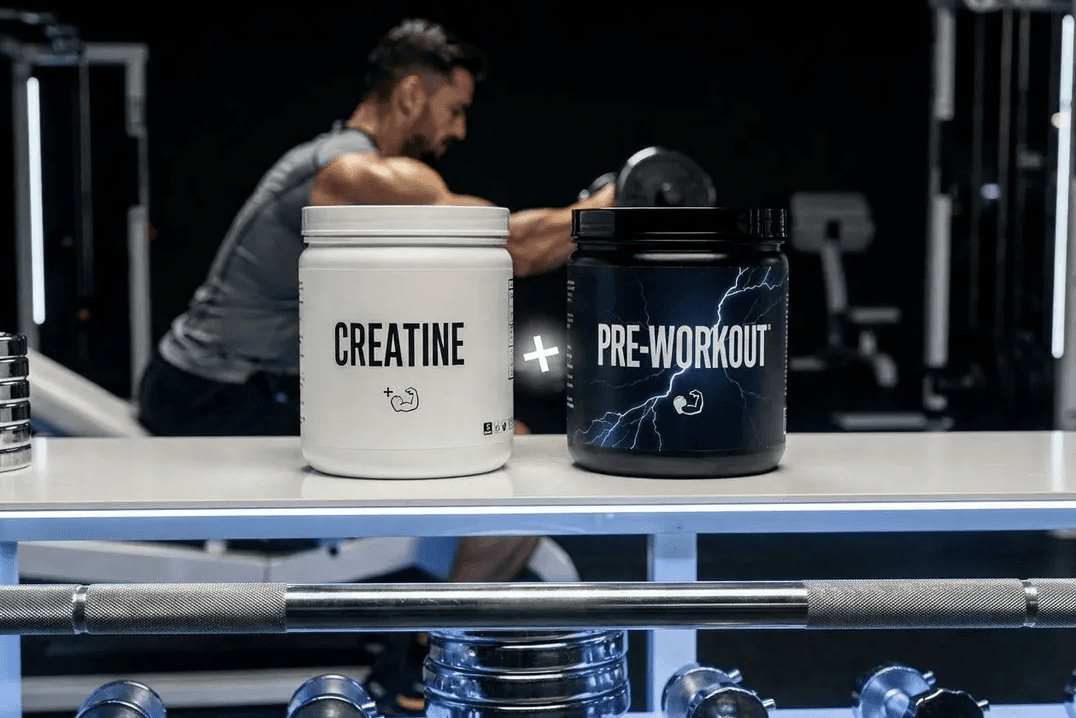
Creatine vs. Pre-Workout: What’s the Difference and Can You Take Both?
Creatine and pre-workout are not the same thing. Creatine is taken daily to build up muscle creatine stores over time, which supports strength, power, and repeated high-intensity efforts. Pre-workout is taken before training for same-day energy, focus, pumps, or perceived intensity. You can take both together, but creatine works through consistent daily use, not as an occasional pre-training ingredient. The confusion mostly comes from the fact that some pre-workouts include creatine, and some people happen to take their creatine before training. That does not make them the same product.
The Short Answer: Creatine Is Long-Term, Pre-Workout Is Same-Day
Creatine builds up in your muscles over days and weeks. The benefit is not from taking it right before a session. It is from keeping muscle creatine stores consistently elevated so your body can regenerate ATP faster during short, intense efforts.
Pre-workout is designed to do something within the same session. You take it 30 to 60 minutes before training and it influences energy, focus, blood flow, or perceived effort during that workout.
Neither is automatically better. They solve different problems. Think of it this way: creatine is long-term performance support, and pre-workout is acute training-session support.
Creatine vs Pre Workout: Quick Comparison
Factor | Creatine | Pre-Workout |
|---|---|---|
Primary purpose | Strength, power, repeated high-intensity performance | Energy, focus, pumps, workout intensity |
How fast it works | Builds over days to weeks | Same-day, within 30–60 minutes |
Typical timing | Daily, anytime | 30–60 minutes before training |
Typical dose | 3–5 g/day | Ingredient-dependent |
Main ingredients | Creatine monohydrate | Caffeine, citrulline, beta-alanine, taurine, tyrosine, electrolytes, nitrates, sometimes creatine |
Stimulants | None | Often yes; stimulant-free options exist |
Best for | Strength, power, high-intensity training | Energy, focus, pumps, perceived effort |
Can it be taken daily? | Yes, recommended | Possible, but stimulant tolerance is a concern |
Biggest watchout | Underdosed in many pre-workouts | Excessive caffeine, proprietary blends, underdosed key ingredients |
Format examples | Powder, gummies, gels, chews, RTDs, capsules | Powder, shots, RTDs, gels, capsules |
What Is Creatine?
Creatine is a naturally occurring compound found in your body and in foods like meat and fish. Your liver, kidneys, and pancreas produce around 1 to 2 grams per day from amino acids. Supplementing adds to that.
It is not an amino acid itself. It is synthesized from amino acids, but calling it an amino acid supplement would be inaccurate.
Its main role is in the phosphocreatine system. During short, maximal efforts like sprinting or heavy lifting, your muscles burn through ATP fast. Phosphocreatine donates a phosphate group to regenerate ATP without needing oxygen or glucose. Supplementation can increase total muscle creatine stores by 10 to 40%, which expands that reservoir.
Creatine monohydrate is the most studied form. The ISSN position stand states it is the most effective ergogenic nutritional supplement currently available for increasing high-intensity exercise capacity and lean body mass during training, and no other form has been shown to outperform it.
The standard maintenance dose is 3 to 5 grams per day. Loading (20 g/day for 5 days) is optional and only speeds up the time to saturation. Consistency matters more than exact timing.
What Is Pre-Workout?
Pre-workout is a category, not a single ingredient. Products vary widely by brand, serving size, and intended effect.
Most are multi-ingredient formulas. Common ingredients include caffeine, L-citrulline, beta-alanine, taurine, L-tyrosine, electrolytes, carbohydrates, nitrates, and sometimes creatine. Some are stimulant-based. Some are stimulant-free, targeting pumps, hydration, or focus without caffeine.
The actual effect depends entirely on what is in the product and at what dose. A product with 200 mg of caffeine and 6 g of citrulline will behave very differently from one with 50 mg of caffeine and a proprietary blend that hides everything else. Not all pre-workouts are effective, and not all are necessary.
Does Creatine Work Like Pre-Workout?
Not in the usual sense. Creatine does not give you the immediate "kick" people associate with caffeine-based pre-workouts. You will not feel it working on day one the way you feel caffeine.
Its benefits come from consistent use over time. Once muscle creatine stores are elevated, your body has more capacity to regenerate ATP during intense efforts. That is a cellular-level change, not a stimulant effect.
Taking creatine before training is fine, but the timing is not what drives the benefit. The benefit comes from daily consistency. Creatine should not be positioned or expected to work like an energy drink.
Can You Take Creatine and Pre-Workout Together?
Yes. Many people take creatine and pre-workout on the same day without issue. Creatine timing is flexible, so you can take it before training, after, or at another convenient time.
The main things to check:
Does the pre-workout already contain creatine?
If so, is it a full 3 to 5 gram dose, or a smaller amount included for label appeal?
Nearly 44% of ingredients in commercially available pre-workouts are hidden in proprietary blends, which makes it hard to know whether you are getting a meaningful creatine dose.
What is the total caffeine amount? Stacking a pre-workout with other caffeinated products can push intake too high.
If the pre-workout contains 1 to 2 grams of creatine, adding a separate 3 to 5 gram creatine supplement on top is reasonable. If it already contains a full dose, you do not need to add more.
Should Creatine Be in a Pre-Workout?
It depends on the product goal. Creatine can be included in a pre-workout, but there is a practical tension here that brands and consumers both need to understand.
Creatine works through daily saturation. Pre-workout is typically taken only on training days. If someone trains three or four days per week and only gets creatine from their pre-workout, they are probably not dosing it consistently enough to maintain elevated muscle creatine stores.
There is also a serving size issue. A full 3 to 5 gram creatine dose takes up real formula space. Combined with meaningful doses of citrulline (6 to 8 g), beta-alanine (3 to 4 g), and other actives, the serving size becomes large, and the product harder to formulate, flavor, and consume.
Some brands add small amounts of creatine, say 1 to 2 grams, primarily because it looks good on the label. That amount is unlikely to match the evidence-based dosing needed for meaningful benefit.
For consumers focused on creatine saturation, a separate daily creatine product is usually more reliable. For brands, the question of whether creatine belongs in a pre-workout comes down to whether the formula can actually deliver a meaningful dose consistently.
Creatine or Pre-Workout for Muscle Growth?
Creatine is the more foundational supplement here. Meta-analyses consistently show strength gains of 5 to 15% above placebo when creatine is combined with resistance training. Greater training volume over time supports muscle-building, assuming protein intake, sleep, and progressive overload are in place.
Pre-workout may help some people train harder or feel more motivated in a session. But it does not replace the fundamentals. If you are choosing one supplement to support long-term strength and muscle development, creatine is usually the better starting point.
Creatine or Pre-Workout for Energy?
Pre-workout usually wins for same-day perceived energy, especially if it contains caffeine. Caffeine blocks adenosine receptors, reduces fatigue, and increases alertness. That is a direct, noticeable effect.
Creatine does not feel like caffeine. It supports ATP regeneration during high-intensity work at a cellular level. That is a meaningful performance benefit, but it is not the same as feeling stimulated. Do not expect creatine to feel like an energy drink.
Stimulant-free pre-workouts may target pumps, hydration, or focus without caffeine-driven energy, which is worth knowing if you train in the evening or are sensitive to stimulants.
Creatine or Pre-Workout for Endurance?
Creatine's benefits are most supported for repeated short, intense efforts. As exercise duration extends beyond two to three minutes, the oxidative system dominates ATP synthesis and creatine's ergogenic potential diminishes. For long-distance running, cycling, or sustained aerobic work, creatine is less relevant.
Pre-workout effects for endurance depend on the ingredient profile. Caffeine has a small but meaningful effect on endurance performance at moderate doses. Electrolytes and carbohydrates may be more relevant for longer sessions than stimulants or pump ingredients.
The right choice depends on training style, duration, and goals.
Creatine or Pre-Workout for Pumps and Focus?
Pre-workout formulas usually dominate here. Ingredients like L-citrulline support nitric oxide production and vasodilation. Caffeine and L-tyrosine support alertness and focus under fatigue. These are not things creatine does.
Some hybrid products combine multiple goals. But a long ingredient list does not mean a strong product. Check whether each ingredient is present at a dose that matches the evidence. Citrulline needs 6 to 8 grams to be meaningful. Many products list it in a blend totaling less than that across eight or more ingredients.
Timing: When Should You Take Each?
For creatine, take 3 to 5 grams daily. Timing is flexible. Post-workout with a meal works well for many people, but the most important thing is that you take it consistently, including on non-training days. Research shows that timing around exercise does not significantly affect outcomes for creatine.
For pre-workout, take it 30 to 60 minutes before training. Avoid stimulant-heavy products late in the day if sleep is a concern. Follow label directions and be honest about your caffeine tolerance.
What About Caffeine and Creatine Together?
You can take creatine and caffeine on the same day. Modern research shows no serious pharmacokinetic interaction between them. Caffeine does not affect creatine's ability to increase muscle phosphocreatine storage.
Some older studies suggested caffeine might blunt creatine's effects, but this evidence is weak and mainly seen in studies using high-dose caffeine during a loading protocol. For most people taking 3 to 5 grams of creatine daily and moderate caffeine on training days, there is no strong reason for concern.
Practical advice: do not panic about combining them, but avoid excessive caffeine, pay attention to stomach comfort, and monitor sleep quality. If you are sensitive to caffeine or doing a loading protocol, you can separate them if you prefer.
Product Format Matters: Powders, Shots, Gels, Gummies, RTDs, and Chews
Creatine and pre-workout are no longer just scoop-and-shake powders. The format landscape has expanded significantly, and format choice affects dosing, convenience, stability, taste, and how well the product actually works.
Creatine now appears in powders, gummies, gels, chews, RTDs, and capsules. Searches for creatine gummies have increased more than 1,300% according to The Vitamin Shoppe's 2025 Trend Report, and gummy sales have seen a 360% year-over-year increase. Pre-workout comes in powders, shots, RTDs, gels, capsules, and hybrid creatine/pre-workout formulas.
Each format involves real tradeoffs:
Powders offer dosing flexibility and are cost-effective, but require mixing and can have texture or taste issues at high payloads.
Gummies and chews improve convenience and adherence, but fitting a full 3 to 5 gram creatine dose into a reasonable number of gummies is a genuine formulation challenge, and sugar content can add up.
Gels and shots are convenient for on-the-go use but require careful management of concentration, taste, texture, and stability in a small volume.
RTDs offer the best convenience but introduce the most formulation complexity. Creatine monohydrate can degrade into creatinine in water over time, particularly at lower pH or higher temperatures. Stability, sedimentation, flavor masking, and shelf-life validation all become critical.
For product developers, the format has to match the ingredient's actual use case. As we explain in our work on what makes a functional drink actually functional, "a poorly formulated beverage can contain the right ingredients at the right doses and still deliver almost nothing — because those ingredients separated, degraded, or became biologically inaccessible before anyone drank them."
Solubility, stability, and bioavailability are not afterthoughts. They determine whether the product on the shelf matches what was intended at the formulation stage. Our ingredient technology is designed specifically to address these challenges for hard-to-formulate actives, including creatine.
What to Check on the Label
Before buying a creatine, pre-workout, or hybrid product, run through this checklist:
Does the pre-workout contain creatine?
How many grams of creatine per serving? Is it 3 to 5 grams, or a smaller amount?
Is the creatine form listed as creatine monohydrate?
How much caffeine is included per serving?
Are there additional stimulants beyond caffeine?
Are pump ingredients like citrulline listed at meaningful doses, or buried in a blend?
Are there added sugars or carbohydrates that affect your goals?
Is the product third-party tested for purity and label accuracy?
Does the serving size seem realistic to consume?
Are there proprietary blends that hide individual ingredient amounts?
A product's effectiveness depends on transparent dosing and a clear formulation purpose. A long ingredient list with hidden amounts tells you very little about what you are actually getting.
For Brands: Why Combining Creatine and Pre-Workout Is Harder Than It Looks
Combining creatine with pre-workout ingredients can make sense, but only if the formula has a clear reason to exist. Before starting development, brands need to answer a basic question: is this a daily creatine product, a pre-workout, or a hybrid? The answer shapes everything else.
Creatine needs a meaningful daily dose. Pre-workout ingredients need timing-specific effects. Those two requirements pull in different directions when it comes to how the product is used and how often.
Full-dose formulas can become large, gritty, bitter, and hard to flavor. A 5 gram creatine dose combined with 6 to 8 grams of citrulline, 3 to 4 grams of beta-alanine, and other actives creates a high-payload serving that is genuinely difficult to make palatable in a powder, let alone a shot or RTD.
RTDs, gels, shots, and chews add another layer of complexity. As we cover in our solubility article, when hard-to-solubilize actives are not handled correctly, the practical consequence is inconsistent dosing. Separation, sedimentation, pH instability, flavor breakdown, and shelf-life failures are all real risks, not theoretical ones. This is not just a quality issue; it is a product integrity issue.
Brands should avoid adding creatine to a pre-workout simply because it looks good on a Supplement Facts panel. If the dose is not meaningful and the product is not used daily, the creatine is not doing what it is supposed to do.
For brands developing creatine products, pre-workouts, RTDs, shots, gummies, or hybrid formats, our ingredient delivery platform is built to solve the stability, solubility, and clean-label formulation challenges that come with high-payload active nutrition products. We explicitly list creatine among the hard-to-formulate nutrients we transform into stable, water-soluble ingredients, in both liquid and powder formats, designed to survive pasteurisation, carbonation, and a minimum 24-month shelf life without harsh chemicals.
Which Is Better: Creatine or Pre-Workout?
For long-term strength, power, and repeated high-intensity performance, creatine is usually the better foundational supplement. The evidence base is strong, the safety record is excellent, and the mechanism is well understood.
For same-day energy, focus, pumps, and perceived workout intensity, pre-workout may be more noticeable, particularly if it contains caffeine and well-dosed pump ingredients.
Many people use both. The best choice depends on your goals, training style, stimulant tolerance, budget, and whether you want daily support or session-specific support. Neither is universally better. They serve different purposes.
Common Questions About Creatine and Pre-Workout
Is creatine the same as pre-workout?
No. Creatine is a specific compound taken daily for long-term muscle creatine saturation. Pre-workout is a category of multi-ingredient products taken before training for same-day effects. Some pre-workouts contain creatine, but that does not make them the same thing.
Is creatine better than pre-workout?
For long-term strength and power support, creatine is usually more foundational. For same-day energy or focus, pre-workout may be more noticeable. They serve different purposes, so "better" depends on what you are trying to achieve.
Can I take creatine and pre-workout together?
Yes. Check the creatine dose in your pre-workout, monitor total caffeine intake, and follow label directions. Most people can combine them without issue.
Should I take creatine before or after pre-workout?
Creatine timing is flexible, so take it whenever is convenient. Pre-workout is typically taken 30 to 60 minutes before training. You can take creatine at the same time as pre-workout or separately.
Does pre-workout already have creatine?
Some do, some do not. Many that include creatine do not provide a full 3 to 5 gram dose. Always check the label and look for disclosed amounts rather than proprietary blends.
Is creatine a stimulant?
No. Creatine does not act on the central nervous system the way caffeine does. It supports ATP recycling during intense exercise but does not create a stimulant effect.
Does creatine give you energy?
Not in the way caffeine does. Creatine supports cellular energy recycling during high-intensity work, which can improve performance over time. But you will not feel an immediate energy boost from taking it.
Should beginners take creatine or pre-workout?
Beginners usually benefit most from focusing on training consistency, nutrition, sleep, and protein intake first. If adding a supplement, creatine is a simpler and well-supported starting point. Pre-workout is optional and not necessary for progress.
Can I take creatine every day and pre-workout only sometimes?
Yes, and this is a common and practical approach. Daily creatine maintains muscle saturation. Pre-workout on training days provides session-specific support. The two are designed to work on different timescales.
Is it better to buy creatine separately from pre-workout?
Often yes. A standalone creatine product makes it easier to dose consistently and accurately. If your pre-workout underdoses creatine or you do not train every day, a separate creatine supplement gives you more control.
Can creatine replace pre-workout?
No. Creatine supports long-term performance but does not replicate the acute energy, focus, or pump effects that many pre-workout formulas provide. They do different jobs.
What should brands know before making a creatine pre-workout?
Define the product's purpose clearly. Dose creatine at a meaningful level. Manage serving size, taste, and texture at high payloads. Validate stability across the intended format and shelf life. Avoid adding creatine just for label appeal. And consider whether the product's use frequency actually supports daily creatine saturation.
Different Tools, Different Jobs
When it comes to creatine vs pre workout, the core takeaway is straightforward. Creatine is best taken daily for long-term strength and performance support. Pre-workout is best used before training for acute energy, focus, pumps, or perceived effort. You can take both, but check the label, avoid underdosed formulas, and do not rely on pre-workout as your only creatine source unless it provides a full daily dose and you use it consistently enough to maintain saturation.
For brands developing products in this space, the formulation decisions matter as much as the ingredient choices. Format, dose, stability, and solubility all determine whether the finished product delivers what the label promises. If you are building a creatine product, a pre-workout, an RTD, a shot, a gel, a gummy, or a hybrid formula and need a clean-label ingredient delivery partner who understands the real-world challenges of high-payload active nutrition, explore what we do at Infusd and how our applications across beverages, supplements, and functional formats can support your next product.