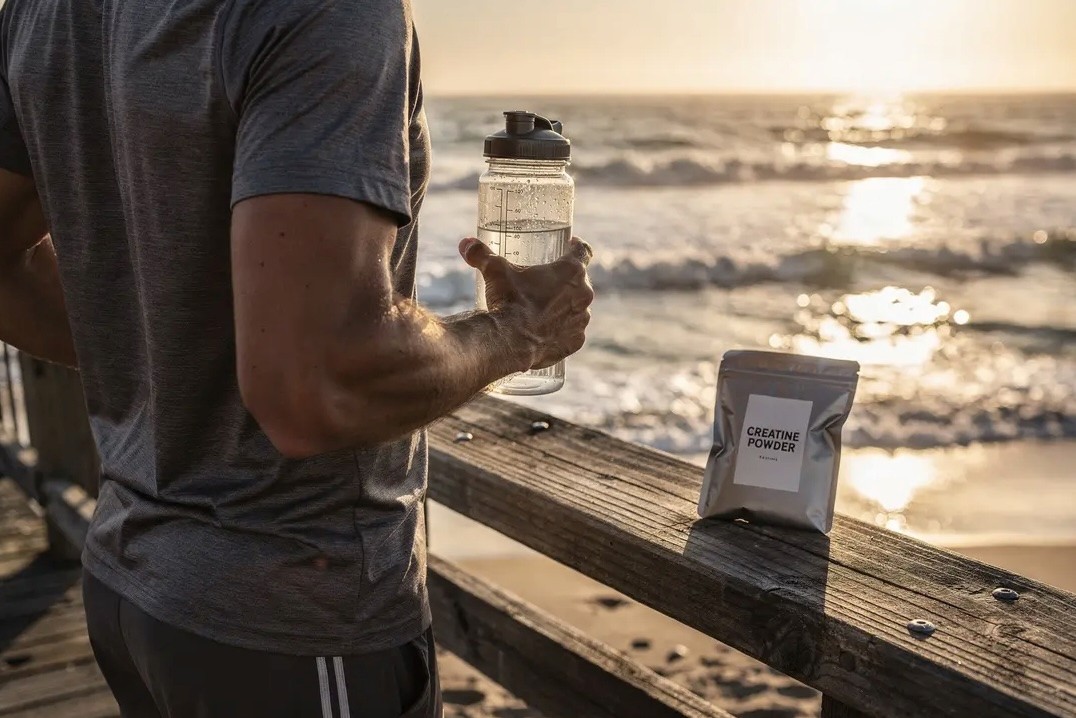
How Much Water Should I Drink on Creatine? What You Need to Know
Most people can take creatine with 8–12 ounces (250–375 mL) of water or another beverage, then focus on meeting their normal daily hydration needs. That's the short answer. But the question "how much water should I drink on creatine" actually covers two different things: how much liquid to use when taking a creatine serving, and how much total fluid to drink throughout the day. Creatine doesn't require extreme water intake, but hydration still matters for training performance, digestion, and comfort. This guide covers both, plus dehydration myths, water retention, loading phases, supplement formats, and what brands should know about creatine product design.
How Much Water Should I Drink on Creatine? The Short Answer
For a standard 3–5 gram serving of creatine powder, 8–12 ounces of water or another beverage is a practical starting point. The exact amount doesn't need to be perfect. More water tends to make powder mix more smoothly, especially if it feels gritty or settles quickly. Less water is fine if you don't mind a thicker texture.
For non-powder formats like capsules, gummies, gels, or chews, you don't need a full glass just to take the serving. But your overall daily hydration still matters regardless of format.
The key distinction: creatine serving fluid is about mixability and comfort. Daily hydration is about your body, your training, and your environment. Creatine works through consistent daily intake and muscle creatine saturation over time. The amount of water in your glass doesn't change how well it works.
How Much Water Should You Drink Per Day While Taking Creatine?
There's no single daily water target that applies to everyone on creatine. Daily fluid needs depend on body size, training intensity, sweat rate, climate, sodium intake, diet, caffeine intake, and activity level. Someone running outdoors in summer has very different needs from someone lifting in an air-conditioned gym.
A rough guideline for active adults is around 3–4 liters of fluid per day, but that varies significantly. Pale yellow urine is a useful general check. Dark urine, strong thirst, headaches, or sluggish workouts can all point to needing more fluid.
People who sweat heavily, train outdoors, use saunas, or live in hot climates may need more fluid and electrolytes. The better approach is to drink regularly throughout the day, pay attention to how you feel, and adjust based on what your body is telling you rather than chasing a fixed number.
As we explain in our creatine hydration guide, there's no universal rule that says creatine users must drink a gallon of water a day. That idea is an oversimplification.
Do You Need Extra Water When Taking Creatine?
Not automatically. Creatine doesn't come with a mandatory extra water requirement. What it does is help increase muscle creatine stores over time, and some early weight gain from creatine is related to water stored inside muscle cells. That's not dehydration, and it doesn't mean you need to flood your system with extra fluid to compensate.
The better approach is steady, consistent hydration throughout the day, especially around workouts. Don't overcorrect by forcing excessive water intake. That creates its own problems and doesn't improve how creatine works.
Does Creatine Cause Dehydration?
This is one of the most persistent myths in sports nutrition, and it doesn't hold up. Creatine doesn't appear to automatically cause dehydration when used appropriately. The International Society of Sports Nutrition found no research supporting claims that creatine causes dehydration or muscle cramping. A 2025 review in Frontiers in Nutrition confirmed that controlled studies show no detrimental effects on thermoregulation or hydration status from creatine supplementation, even in hot and humid conditions.
Dehydration risk is more closely tied to inadequate fluid intake, high sweat loss, heat, alcohol, illness, diuretics, or long training sessions. Creatine users should pay attention to hydration because many are active people with higher fluid needs, but creatine itself isn't the cause of dehydration in people who are otherwise taking care of themselves.
Creatine and Water Retention: What Is Actually Happening?
Creatine can cause a small early increase in body weight for some people. This is typically related to increased water storage inside muscle cells, not under the skin. It's intracellular water retention, which is different from bloating, puffiness, or fat gain.
For every gram of creatine stored in muscle, roughly 3–4 grams of water are retained within the cell. During a loading phase, this can add up to around 1–3 kg of body mass in the first week, mostly from water. Over the long term, several studies suggest creatine doesn't significantly alter total body water relative to muscle mass.
Some people experience temporary stomach discomfort when taking too much creatine at once or when powder is poorly mixed. Smaller doses, more liquid, better mixing, or taking creatine with food can help with comfort.
How Much Water Should You Mix With Creatine Powder?
For a 5 gram serving of creatine powder, 8–12 ounces of water is a practical starting point. If the powder feels gritty or settles at the bottom, using more liquid helps. Standard creatine monohydrate has limited solubility in cold water, so a 5 gram dose in a small glass will likely leave some undissolved particles. If you don't drink the sediment, you're leaving part of your dose behind. Swirl and drink it all.
Micronized creatine has smaller particles, which means it disperses more evenly in liquid and tends to feel less gritty. It doesn't require a different water ratio, but you may find it more pleasant in smaller volumes. You can read more about how micronization affects texture and dispersion in our micronized creatine vs. creatine monohydrate breakdown.
Creatine doesn't need to be mixed only with water. Juice, smoothies, coffee, and tea all work if the product label allows. The important thing is consuming the full serving consistently.
Does More Water Make Creatine Work Better?
No. More water may make the drink smoother and easier on the stomach, but it doesn't change the dose or increase how much creatine reaches your muscles. Creatine works by gradually increasing creatine stores in muscle cells over time. That process depends on how much creatine you take and how regularly you take it, not on whether you used 8 ounces or 16 ounces of water.
Hydration supports training quality, but water doesn't "activate" creatine. Too much water too quickly can also be uncomfortable and, in extreme cases, unsafe. The goal is adequate hydration, not forced overhydration.
Creatine Loading: Should You Drink More Water?
A loading phase typically involves 20 grams of creatine per day, split into four or five servings of 5 grams each, for 5–7 days. Because total creatine intake is higher during loading, it's worth paying closer attention to hydration. But this doesn't mean drinking extreme amounts of water.
Splitting the loading dose into smaller servings and taking each with 8–12 ounces of fluid improves digestive comfort and makes for a much better experience than trying to mix 20 grams at once. As the ISSN notes, dosages above 10 grams at once may lead to gastrointestinal discomfort.
Loading is optional. Many people skip it and use a consistent 3–5 gram daily dose instead, reaching full muscle saturation in 3–4 weeks rather than a few days. Either approach works.
How Training Changes Hydration Needs on Creatine
Creatine is often used by people who train hard, and training is what drives most of the hydration demand. Johns Hopkins Medicine notes that people can lose up to 2 quarts of fluid per hour through sweat during activity. A body weight drop of around 2% from dehydration can start to affect performance and cognitive function.
Sweat rate varies widely between individuals. Long workouts, hot weather, high humidity, heavy clothing, and outdoor training all increase fluid needs. Electrolytes matter when sweat losses are high, especially during long or hot sessions. Drinking too much plain water without replacing electrolytes can dilute sodium levels.
Strength athletes, endurance athletes, field athletes, and casual gym users all have different hydration patterns. Adjust based on thirst, urine color, post-workout body weight changes, and how your training feels.
Signs You May Need More Fluids
These signs can have multiple causes and aren't automatically caused by creatine, but they're worth paying attention to:
Dark yellow urine
Strong thirst
Dry mouth
Headache
Dizziness
Unusual fatigue
Muscle cramps during hot or sweaty training
Poor workout performance
Rapid body weight drop after training
Not urinating for long periods
If you're consistently experiencing several of these, look at your total daily fluid intake, training conditions, and diet before assuming creatine is the issue.
Can You Take Creatine Without Water?
It depends on the format. Creatine powder should be mixed with liquid. Taking it as a dry powder without any liquid creates a choking risk, can irritate your esophagus, and makes accurate dosing harder. There's no benefit to dry scooping. Don't do it.
Capsules, gummies, gels, and chews don't require a full glass of water for the serving itself. But drinking some fluid alongside them may still improve comfort. And regardless of format, your normal daily hydration needs don't go away. The delivery format changes the serving experience, not your body's overall need for fluids.
Product Format Matters: Powder, Gummies, Gels, Capsules, Chews, Shots, and RTDs
Creatine is no longer just a scoop-and-shake powder. Consumers now use creatine in powders, micronized powders, gummies, gels, chews, capsules, ready-to-drink beverages, shots, and hybrid creatine/pre-workout products. Each format has different water needs, usability tradeoffs, and formulation challenges.
Powders need the most liquid for mixing and mouthfeel. Capsules are convenient but may require multiple pills to reach a full dose. Gummies and chews are popular but create tradeoffs around serving size, sugar content, and dose consistency. As we cover in our creatine gummies vs. powder comparison, many gummies contain only 1–2 grams per piece, meaning users may need five or more to hit an effective dose.
RTDs improve convenience but create real formulation challenges. Standard creatine monohydrate is unstable in water, particularly at acidic pH. At the pH range of typical energy drinks (2.5–4.0), creatine can degrade significantly within weeks. Shots and gels are portable but must manage concentration, taste, texture, and stability carefully.
The best format depends on the consumer's routine and the brand's ability to deliver a meaningful, stable dose in a product people will actually use consistently. A product with the right dose in the wrong format isn't a functional product. As we explain in our piece on what makes a functional drink actually functional, solubility, stability, and bioavailability all have to work together.
Hydration vs. Mixability: Why They Are Not the Same Thing
Drinking enough water and mixing creatine well are related but separate issues. A product can be consumed with plenty of fluid and still feel gritty, chalky, or unpleasant. A product can mix smoothly while the user still needs to stay hydrated throughout the day. These are not the same problem.
Mixability depends on dose, particle size, liquid volume, temperature, agitation, and the beverage matrix. Solubility is how much creatine actually dissolves in liquid at a chemical level. Standard creatine monohydrate has a water solubility of approximately 14 g/L at 20°C, which means a typical 5 gram dose in 250 mL exceeds the saturation point. The undissolved particles are still bioavailable, but they settle. Swirl and drink them.
Better mixability doesn't automatically mean better absorption. And more water doesn't magically change the dose. As we outline in our solubility explainer, presence in a product is not the same as effective delivery. For product developers, the goal isn't just adding creatine to a formula. It's delivering the dose in a format people will use consistently, with a sensory experience that doesn't get in the way.
For Brands: Why Creatine Hydration Claims Need to Be Careful
Brands developing creatine products should avoid two common mistakes: implying that creatine automatically dehydrates people, and telling consumers to drink extreme amounts of water. Both are inaccurate and can undermine consumer trust.
Better consumer education focuses on dose, format, training context, sweat loss, comfort, and practical hydration habits. If a product requires too much liquid, tastes unpleasant, settles quickly, or feels gritty, users won't take it consistently. And inconsistent use is the main reason creatine doesn't work for people, not water intake.
Functional formats need to balance dose, taste, texture, convenience, stability, and label claim accuracy. Grittiness, sediment, and chalky texture aren't user errors. They're formulation problems. If a product is consistently unpleasant regardless of how much water someone uses, that's worth addressing at the formulation level.
At Infusd, we work with brands to transform hard-to-formulate ingredients like creatine into stable, water-soluble formats that dissolve cleanly with minimal agitation. The goal is to make the product experience match the dose on the label. You can explore how we approach this through our ingredient technology and applications.
Practical Hydration Tips While Taking Creatine
Take creatine powder with 8–12 ounces of water or another beverage.
Drink fluids regularly throughout the day rather than all at once.
Increase fluid intake when training hard, sweating heavily, or spending time in heat.
Consider electrolytes during long, hot, or sweaty training sessions.
Watch thirst, urine color, energy levels, and workout performance as practical guides.
Don't force excessive water intake. Adequate hydration is the goal, not overhydration.
Avoid dry scooping creatine.
Follow the serving size on the product label.
If you're pregnant, managing kidney disease, taking medications, using diuretics, or dealing with a medical condition, ask a healthcare professional before using creatine.
Quick Comparison: Creatine Formats and Water Needs
Here's a practical overview of how water needs vary by format:
Powder — Usually 8–12 ounces per serving. More fluid may improve mixability and reduce grittiness.
Micronized powder — Usually 8–12 ounces. Smaller particles disperse more evenly, so it may feel smoother in less liquid.
Capsules — A few ounces or more is fine. May require multiple capsules to reach a full dose.
Gummies — Little water needed for the serving itself. Daily hydration still matters. Watch serving size and dose per piece.
Chews — Little water needed for the serving itself. Texture and dose accuracy matter.
Gels — Usually little additional water. Concentration, taste, and texture are the main considerations.
RTDs — Fluid is built into the product. Stability, sediment, pH, and label claim accuracy are key formulation challenges.
Shots — Fluid is built into the product. Strong flavor masking and active concentration management are often needed.
FAQs About Creatine and Water Intake
How much water should I drink with creatine?
Most people can take creatine with 8–12 ounces of water or another beverage. More water may help powder mix more smoothly, especially if it feels gritty or settles quickly.
How much water should I drink per day on creatine?
There's no single number for everyone. Daily needs depend on body size, activity level, sweat rate, climate, diet, and training intensity. Monitor thirst, urine color, and workout performance rather than chasing a fixed target.
Do I need to drink more water when taking creatine?
Not necessarily. Creatine doesn't require extreme water intake. But active people should pay attention to hydration because training and sweat loss increase fluid needs regardless of whether you're taking creatine.
Does creatine cause dehydration?
Creatine doesn't appear to automatically cause dehydration when used appropriately. Dehydration risk is more closely related to heat, sweat loss, inadequate fluid intake, illness, alcohol, or certain medications.
Does creatine cause water retention?
Creatine can increase water stored inside muscle cells, which may cause a small increase in body weight for some people. This is intracellular water retention, not dehydration, puffiness, or fat gain.
Can I take creatine with less than 8 ounces of water?
You can, but powder may not mix as well. Less liquid means a more concentrated, grittier texture, and some people experience stomach discomfort. Using 8–12 ounces is a practical starting point for most powder servings.
Can I take creatine without water?
Powder should be mixed with liquid. Capsules, gummies, gels, or chews may need less fluid for the serving itself, but your normal daily hydration needs don't change based on format.
Is it bad to dry scoop creatine?
Dry scooping is not recommended. It creates a choking risk, can irritate your esophagus, and makes accurate dosing harder. There's no benefit to it.
Does more water make creatine work better?
No. Creatine works through consistent daily intake over time. More water may help with mixability and comfort, but excessive water doesn't make creatine more effective or speed up muscle saturation.
Should I drink more water during creatine loading?
It's worth paying closer attention to hydration during loading because total creatine intake is higher, but you don't need to force extreme water intake. Splitting servings throughout the day and taking each with fluid improves comfort and tolerance.
How much water should I use with creatine powder?
A good starting point is 8–12 ounces of water or another beverage per serving. More liquid may help if the product feels gritty or leaves sediment at the bottom of the glass.
Do creatine gummies or gels require as much water?
Not usually for the serving itself. Gummies, gels, and chews change the delivery experience, but they don't remove the body's overall need for fluids throughout the day.
The Bottom Line for Creatine, Water, and Better Supplement Design
So, how much water should you drink on creatine? Most people can take creatine with 8–12 ounces of water or another beverage, then focus on staying normally hydrated throughout the day. Daily hydration depends on body size, activity level, sweat rate, climate, diet, and supplement format. Creatine doesn't require extreme water intake, and more water doesn't automatically make it work better.
For consumers, the goal is consistent creatine use and steady hydration. For brands, the goal is to deliver the right dose with better taste, texture, stability, and convenience in formats that fit real consumer behavior.
If you're a brand developing functional creatine formats or working with other hard-to-formulate actives, the challenges around solubility, stability, sensory experience, and active payload are real. We help brands solve those problems. Explore our technology or see our applications to learn how we transform difficult ingredients into stable, consumer-friendly liquid and powder solutions.